Table of contents
- Why UGC-Style Ads Outperform Traditional Creative
- What an AI UGC Ad Generator Actually Does
- Step-by-Step: Launching Your First UGC Ad With No Creative Team
- UGC Ad Generator Comparison: DIY vs. Real Creators vs. AI
- Platform-Specific UGC Ad Strategy for Shopify Stores
- Avoiding the Most Common UGC Ad Mistakes
- Building a Scalable UGC Creative System on a Limited Budget
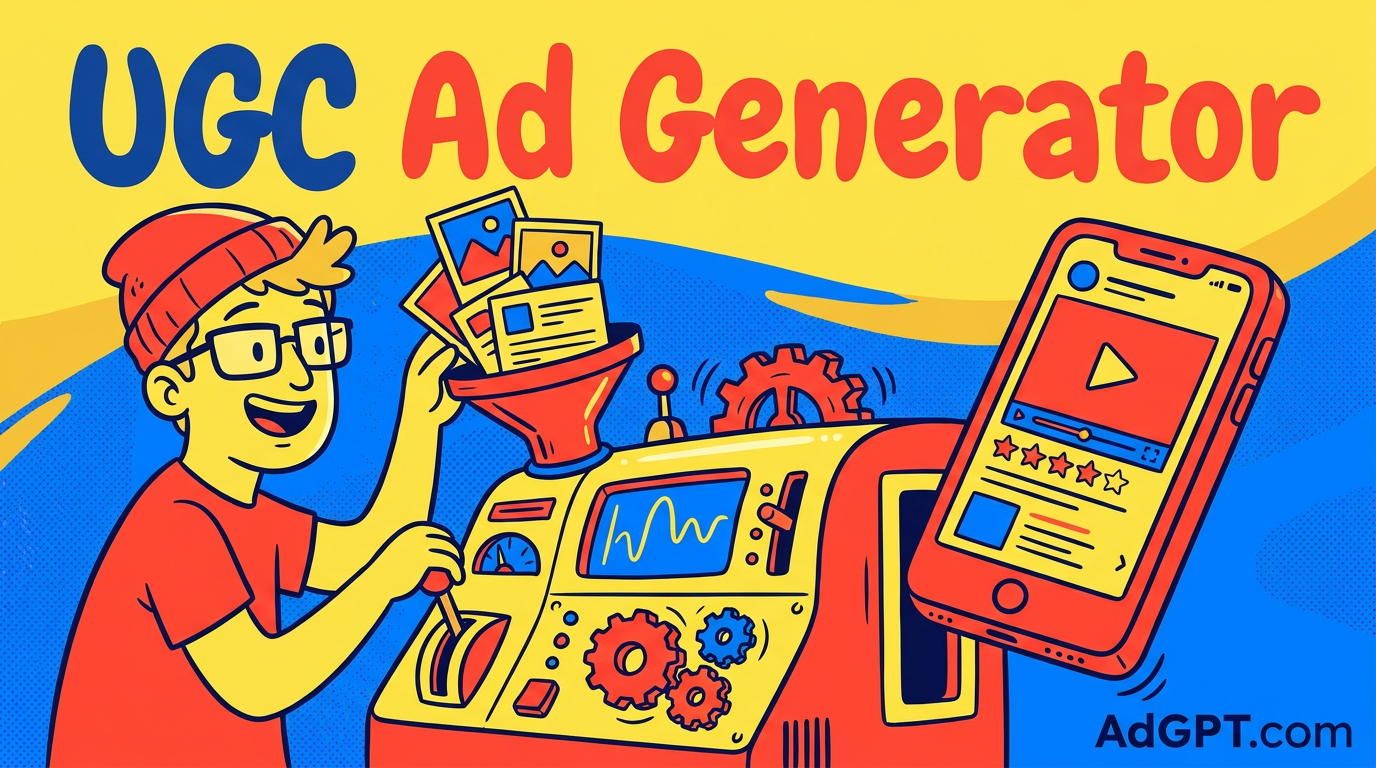
A UGC ad generator uses AI to produce user-generated-style video and static ads — the format that consistently outperforms polished brand creative on Meta, TikTok, and YouTube — without requiring real creators, a production budget, or an agency retainer. For Shopify store owners working with lean resources, this is the fastest path to high-ROAS paid social in 2026.
Why UGC-Style Ads Outperform Traditional Creative
UGC (user-generated content) ads mimic the look and feel of organic social posts: handheld footage, authentic voiceovers, personal testimonials, and real-world product use. That authenticity is not an aesthetic choice — it is a performance signal. Meta's internal data consistently shows that UGC-style creatives drive 4x higher click-through rates compared to polished studio ads when served in-feed. TikTok's own Business Blog reports that ads resembling organic content achieve up to 83% higher engagement rates.
The problem: sourcing real UGC is slow, expensive, and unreliable. A single creator package on platforms like Billo or Insense costs between $150 and $500 per video, with turnaround times of 7 to 21 days. For a Shopify store testing five products simultaneously, that math becomes impossible quickly.
AI-powered UGC ad generators collapse that timeline to minutes and that cost to a fraction of the per-video price — with no back-and-forth with freelancers.
What an AI UGC Ad Generator Actually Does
Modern AI UGC tools are not simple template fillers. The best platforms combine several capabilities in a single workflow:
- AI avatar presenters that simulate a real person holding, demonstrating, or reviewing your product
- Script generation trained on high-converting ad frameworks (hook, problem, solution, CTA)
- Voiceover synthesis in multiple accents, tones, and languages
- Auto-captioning optimized for silent-scroll environments
- Format resizing for 9:16 (TikTok/Reels), 1:1 (Feed), and 16:9 (YouTube)
AdGPT's UGC Ad Generator handles all of the above from a single product URL or a short brief. Store owners paste in their product page, select a creator persona, and receive multiple UGC-style ad variations ready for upload to Meta Ads Manager or TikTok Ads in under ten minutes.
Step-by-Step: Launching Your First UGC Ad With No Creative Team
- Gather your inputs. You need your product URL, three to five key benefits, and your target audience descriptor (e.g., "women 25–45 interested in skincare"). No brief document required.
- Select your ad format. Choose UGC video for TikTok or Reels, or UGC-style static for Meta Feed and Stories. The AI Video Ad Creator handles video; the static generator handles image-based formats.
- Pick an AI persona. Choose from pre-built avatar types — lifestyle presenter, unboxing reviewer, skincare enthusiast — matched to your category. Persona selection affects how authentic the ad feels in-feed.
- Review the AI-generated script. The platform outputs a hook-first script: 3-second pattern interrupt, problem acknowledgment, product proof, and direct CTA. Edit freely or accept as generated.
- Export and resize. Download your ad in all required aspect ratios simultaneously. No manual cropping in Canva or CapCut required.
- Upload and test. Deploy at least two to three variations per ad set. UGC creative fatigue on Meta typically sets in after 5,000 to 8,000 impressions per variation, so having multiple outputs ready from launch prevents performance drops.
UGC Ad Generator Comparison: DIY vs. Real Creators vs. AI
| Method | Cost Per Ad | Turnaround Time | Variations Per Brief | Revision Flexibility |
|---|---|---|---|---|
| Real UGC Creator (Billo/Insense) | $150–$500 | 7–21 days | 1–2 | Low (revision rounds cost extra) |
| In-House Video (iPhone + iMovie) | $0 cash, 4–8 hrs labor | 1–3 days | 1–3 | Medium (limited by skill) |
| Freelance Editor (Upwork) | $75–$250 | 3–7 days | 2–4 | Medium (revision rounds billable) |
| AI UGC Ad Generator (AdGPT) | Included in plan | Under 10 minutes | 5–10+ | High (unlimited regeneration) |
Platform-Specific UGC Ad Strategy for Shopify Stores
Meta (Facebook and Instagram)
Meta's algorithm rewards creative diversity. Running three to five UGC variations per ad set allows the system to identify the top performer and shift budget automatically. Use the Facebook Ads Generator workflow to produce Meta-optimized copy alongside your UGC video assets. Focus hooks on the first 3 seconds — Meta data shows 65% of ad recall is determined within that window.
TikTok
TikTok's For You Page rewards native-feeling content above all else. Ads that open with a question, relatable statement, or unexpected visual perform significantly above benchmark. Captions are critical: 80% of TikTok users watch without sound in public settings. AdGPT's TikTok UGC output includes auto-captions and trend-aware hooks calibrated for the platform's current content patterns.
YouTube Shorts
YouTube Shorts ads under 60 seconds with a UGC feel see average view-through rates of 40–55% compared to 20–30% for traditional pre-roll. Product demonstration scripts work particularly well here. Pair UGC video assets with benefit-first thumbnails generated through the Ecommerce Ad Creator for a cohesive multi-placement strategy.
Avoiding the Most Common UGC Ad Mistakes
Even with AI-generated creative, Shopify store owners frequently leave ROAS on the table through avoidable errors:
- Weak hooks. The opening line must address a pain point or create curiosity. "Check out this product" is not a hook. "I stopped wasting money on X after finding this" is.
- Missing social proof signals. UGC ads perform better when they include a star rating, a specific number ("over 12,000 customers"), or a before/after claim. AI scripts should incorporate these automatically.
- Single-variation launches. Launching one ad and calling it a test is not testing — it is guessing. Always launch a minimum of three variations.
- Ignoring creative fatigue. As covered in detail in Ecommerce Ads That Scale: Beat Creative Fatigue in 2026, frequency above 3.0 on Meta signals exhaustion. AI generators make refreshing creative a weekly habit rather than a quarterly scramble.
- No alignment between ad and landing page. If your UGC ad promises a 30% discount, the landing page must lead with that same offer. Discontinuity kills conversion rates regardless of ad quality.
Building a Scalable UGC Creative System on a Limited Budget
The shift toward AI-generated UGC is not a trend — it is a structural change in how direct-to-consumer brands compete on paid social. As D2C Times has documented across founder-led brand case studies, the stores outperforming their category in 2025 and into 2026 are those treating creative production as a repeatable system rather than a one-time project.
A practical system for a solo Shopify operator looks like this: generate 8–10 UGC variations per product per month, rotate them weekly based on frequency data, and retire any asset that drops below your ROAS floor. With an AI tool handling generation, this workflow takes roughly 90 minutes per week — no agency, no creative director, no Slack threads with freelancers.
The AI Ads Generator from AdGPT is built specifically for this operating model. It handles UGC video, static creative, copy, and resizing inside a single interface, with no design experience required. Store owners scaling from $500 to $50,000 monthly ad spend have used this workflow without adding headcount — a pattern also explored in Shopify Ads at Scale: AI Creative Strategy for Enterprise Brands.
The bottleneck in paid social is almost never budget. It is creative velocity. A UGC ad generator removes that bottleneck permanently.
Frequently asked questions
What is a UGC ad generator?
How much does it cost to use an AI UGC ad generator compared to hiring real creators?
Can UGC-style AI ads actually perform as well as real creator content?
Which platforms work best for UGC ads from Shopify stores?
How many UGC ad variations should a Shopify store test per product?
Do I need any design or video editing skills to use a UGC ad generator?
🤖 Explore this article with AI



Furqan Javed
Get featured in this article
Place your brand in front of thousands of marketers and decision-makers. Pick the articles, add your links and anchor text, and our editors handle the integration — with an answer within 24 hours.
- $200Editorial Mention
- $500Expanded Editorial
- $1,250Featured Placement
We don't do link exchanges or free swaps — placements are paid and subject to editorial review. If a placement isn't approved, it's fully refunded.