Table of contents
- Why Most Shopify Ads Fail (And How to Fix It)
- Choosing the Right Ad Platform for Your Shopify Store
- How to Create Shopify Ad Creative Without a Team
- Step-by-Step: Launch Your First Shopify Ad Campaign
- Budget Allocation Strategy for Small Shopify Stores
- Common Mistakes Shopify Store Owners Make with Paid Ads
- Scaling Shopify Ads Once You Find a Winner
- Final Thoughts: You Do Not Need an Agency to Run Profitable Shopify Ads
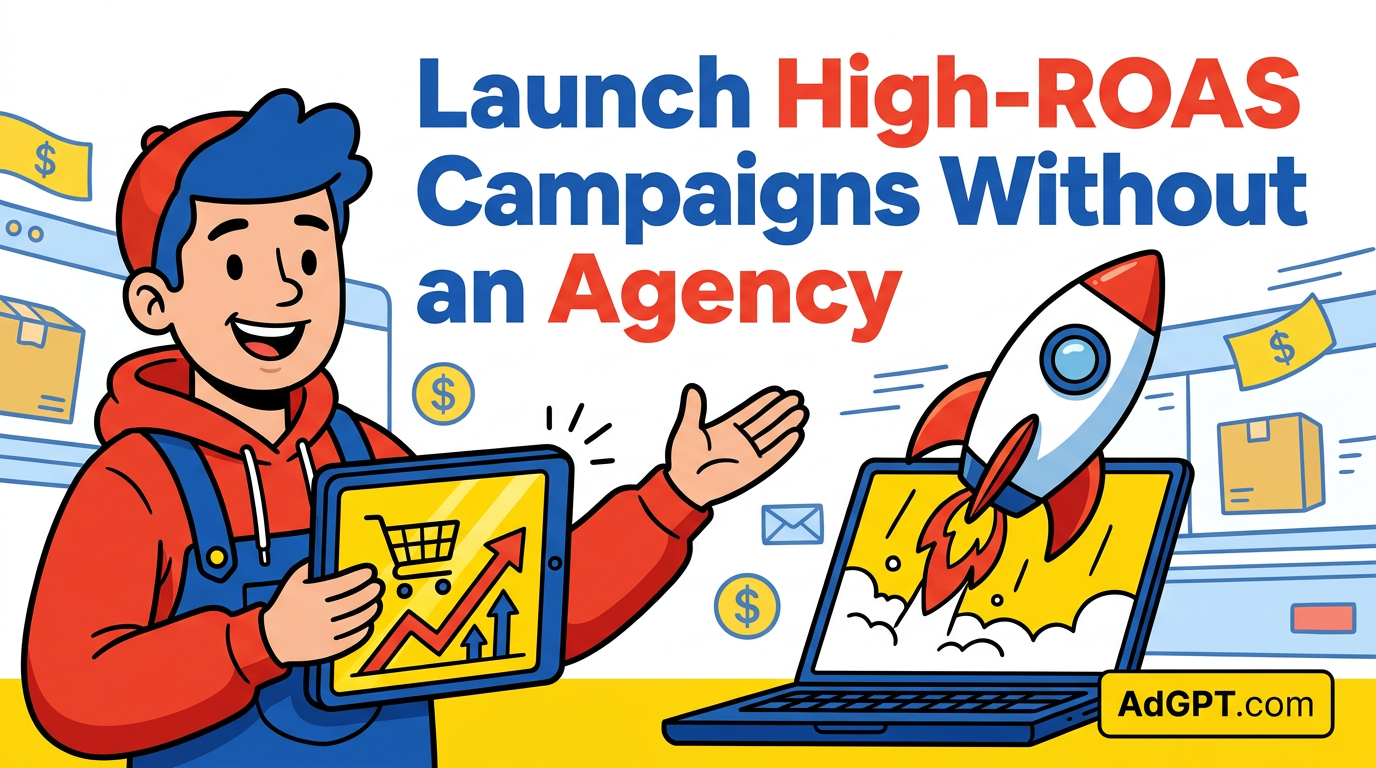
Running Shopify ads without an agency is entirely achievable in 2026. With the right campaign structure, creative assets, and AI-powered tools, solo store owners are generating 3–5x ROAS on budgets as small as $20 per day — no creative team required.
Why Most Shopify Ads Fail (And How to Fix It)
The majority of Shopify store owners who struggle with paid advertising share the same three problems: weak creative, poorly defined audiences, and no testing framework. According to Meta's internal benchmarks, ad creative accounts for up to 70% of campaign performance — meaning your copy, image, or video matters far more than bid strategy or audience targeting alone.
The good news: creative quality is now a solvable problem. AI ad generators have closed the gap between bootstrapped founders and brands with six-figure production budgets. Tools like the AdGPT AI Ads Generator let you produce scroll-stopping static and video ads in minutes, directly from your product URL or Shopify store — no designer, no copywriter, no agency retainer.
Choosing the Right Ad Platform for Your Shopify Store
Platform selection depends on your product category, average order value (AOV), and where your customers actually spend time. Here is a practical breakdown of the major channels available to Shopify merchants in 2026:
| Platform | Best For | Avg. CPC (2026) | Min. Daily Budget | Creative Format |
|---|---|---|---|---|
| Meta (Facebook/Instagram) | DTC, fashion, home goods, beauty | $0.50–$1.80 | $10 | Static, carousel, video, Reels |
| TikTok | Impulse products, Gen Z, viral items | $0.30–$1.20 | $20 | Short-form video, Spark Ads |
| Google Shopping | High-intent buyers, branded search | $0.60–$2.50 | $10 | Product feed, responsive ads |
| YouTube | Considered purchases, AOV $60+ | $0.10–$0.30 CPV | $10 | Pre-roll video, bumper ads |
| B2B Shopify products, wholesale | $3.50–$6.00 | $15 | Sponsored content, lead gen |
For most DTC Shopify stores, Meta and TikTok deliver the strongest early-stage ROAS at manageable spend levels. Start on one platform, prove the economics, then expand.
How to Create Shopify Ad Creative Without a Team
Creative production is the single biggest bottleneck for solo store owners. Hiring a freelance designer for a single static ad set can cost $200–$600. A video production package starts at $1,500. For a store running $500/month in ad spend, that math destroys margins before the first sale.
The alternative is AI-powered creative generation. The AdGPT Ecommerce Ad Creator is built specifically for Shopify merchants — paste your product URL, choose your platform, and receive production-ready ad variants in under two minutes. It handles headline copywriting, visual composition, CTA placement, and platform-specific sizing automatically.
For video specifically, Product Video Ads from AdGPT generate short-form video ads from product images and descriptions — the format that consistently outperforms static on TikTok and Instagram Reels in 2026. No filming, no editing software, no voiceover recording needed.
If Meta is your primary channel, the Facebook Ads Generator produces Facebook- and Instagram-optimized creatives with copy variations pre-loaded for A/B testing — critical for identifying winning angles early.
Step-by-Step: Launch Your First Shopify Ad Campaign
- Install the Meta Pixel (or TikTok Pixel). Before spending a single dollar, ensure your tracking pixel is firing on all pages, especially the order confirmation page. Without accurate purchase data, your campaigns cannot optimize. Verify using Meta's Pixel Helper Chrome extension.
- Define one hero product. Do not advertise your entire catalog in the first campaign. Pick the product with the best margin, strongest reviews, or most repeat purchases. Focus all initial spend on proving that one product works in paid channels.
- Generate 3–5 creative variants. Use an AI tool to produce at least three ad variations — different headlines, different visuals, or different hooks. Creative fatigue sets in fast; you need variants ready before launch, not after performance drops.
- Set up a broad audience campaign. In 2026, Meta's Advantage+ and TikTok's Smart Audience products outperform manually constructed interest stacks for most Shopify stores. Start broad, let the algorithm find buyers, and layer in restrictions only if cost-per-purchase climbs above your target.
- Set a daily budget you can sustain for 14 days. The learning phase on Meta requires approximately 50 purchase events per ad set. At a $30 AOV and 2% conversion rate, plan for $15–$25 per day minimum to exit the learning phase within two weeks.
- Analyze creative performance at day 7. Pull your cost-per-click, click-through rate, and cost-per-purchase by creative variant. Pause anything below a 1% CTR. Double the budget on the variant with the lowest cost-per-purchase.
- Retarget your site visitors. By week two, you should have enough pixel data to build a retargeting audience of product-page visitors who did not purchase. Retargeting campaigns typically deliver 2–4x better ROAS than cold traffic. For a deeper framework, see Retargeting Strategies Enhanced by AI.
Budget Allocation Strategy for Small Shopify Stores
With a limited budget, every dollar of ad spend must have a defined role. The following allocation model works well for Shopify stores spending $500–$2,000 per month on paid media:
- 70% to prospecting campaigns. Cold traffic at broad targeting builds your pixel data pool and fills your retargeting audiences. This is where you find new customers.
- 20% to retargeting. Warm audiences convert at significantly lower cost. Allocate a dedicated budget to cart abandoners, product-page visitors, and past purchasers (for cross-sell).
- 10% to testing. Reserve a fixed slice for creative and offer experiments. Test one variable at a time — a new hook, a different CTA, a price-anchoring headline. This is how you find the next winning ad before your current one fatigues.
According to Affiliate Times reporting on creator-led affiliate strategies, brands that supplement paid ads with affiliate and referral programs cut their effective customer acquisition cost by 18–35% — worth considering once your paid channel is proven and you want to scale without proportionally increasing ad spend.
Common Mistakes Shopify Store Owners Make with Paid Ads
Even with a solid setup, several predictable mistakes consistently erode ROAS for solo operators:
- Sending traffic to the homepage. Every ad should link to a dedicated product page or landing page. The homepage creates decision fatigue and kills conversion rates.
- Changing campaigns before the learning phase ends. Editing budgets, audiences, or creatives resets the learning phase. Make a change, then wait at least five days before evaluating performance.
- Running one creative indefinitely. Even a winning ad fatigues. Frequency above 3.0 on Meta typically signals audience exhaustion. Rotate fresh creative every 3–4 weeks.
- Ignoring mobile experience. Over 80% of Meta and TikTok ad clicks happen on mobile. If your Shopify theme loads slowly or your product images are not mobile-optimized, your landing page is destroying the ROAS your ads are trying to build.
- Skipping social proof in the ad. Ads that reference real reviews, star ratings, or customer counts outperform pure product ads by a measurable margin. Include proof elements in your creative brief when generating ads.
For store owners managing multiple channels simultaneously, the workflow covered in LinkedIn Ads Dashboard for Beginners offers a useful mental model for structuring cross-platform reporting even if LinkedIn is not your primary channel.
Scaling Shopify Ads Once You Find a Winner
Scaling is not simply increasing budgets. Aggressive budget increases — more than 20% in a single day on Meta — typically resets the learning phase and spikes cost-per-purchase temporarily. The safer path is incremental scaling: increase the daily budget by 15–20% every 48–72 hours while monitoring cost-per-purchase against your break-even threshold.
Horizontal scaling — duplicating winning ad sets into new audiences or new placements — often delivers better efficiency than vertical budget increases alone. When you have a proven creative, duplicate the ad set, assign a new audience segment (lookalike from purchasers, for example), and run it at the same budget as your original. If it performs within 20% of the original cost-per-purchase, you have a scalable second lane.
At the point where you are managing multiple campaigns, products, and platforms simultaneously, a full AI ad generation workflow becomes a genuine operational advantage — producing new creative variants, resizing for new placements, and maintaining consistent brand voice without adding headcount.
Final Thoughts: You Do Not Need an Agency to Run Profitable Shopify Ads
The tools, data, and frameworks available to Shopify store owners in 2026 are better than what most agencies were working with three years ago. Pixel-smart campaign structures, AI-generated creative, and platform-native optimization algorithms have collectively lowered the barrier to entry for high-ROAS advertising to a point where a single founder with a defined product and $20/day can compete effectively.
The prerequisite is not budget — it is process. Build a repeatable creative production system, allocate spend with intention, and commit to a testing rhythm. Every step in this article is executable without an agency, without a designer, and without a six-figure ad budget.
Frequently asked questions
How much should a Shopify store spend on ads per day to start?
Which ad platform works best for Shopify stores in 2026?
Can I run Shopify ads without a creative team or designer?
What is a good ROAS target for Shopify ads?
How do I stop my Shopify ads from losing money?
How often should I refresh my Shopify ad creative?
🤖 Explore this article with AI


Furqan Javed
Get featured in this article
Place your brand in front of thousands of marketers and decision-makers. Pick the articles, add your links and anchor text, and our editors handle the integration — with an answer within 24 hours.
- $200Editorial Mention
- $500Expanded Editorial
- $1,250Featured Placement
We don't do link exchanges or free swaps — placements are paid and subject to editorial review. If a placement isn't approved, it's fully refunded.