Table of contents
- Why Affiliate Marketers Need a Dedicated Facebook Ads Generator
- What to Look for in a Facebook Ads Generator Built for Affiliates
- How to Generate High-Volume Compliant Facebook Ads in 5 Steps
- Facebook Ads Generator: Platform Comparison for Affiliates
- Compliance Tactics That Reduce Facebook Ad Rejections
- Scaling Creative Output Without Burning Budget
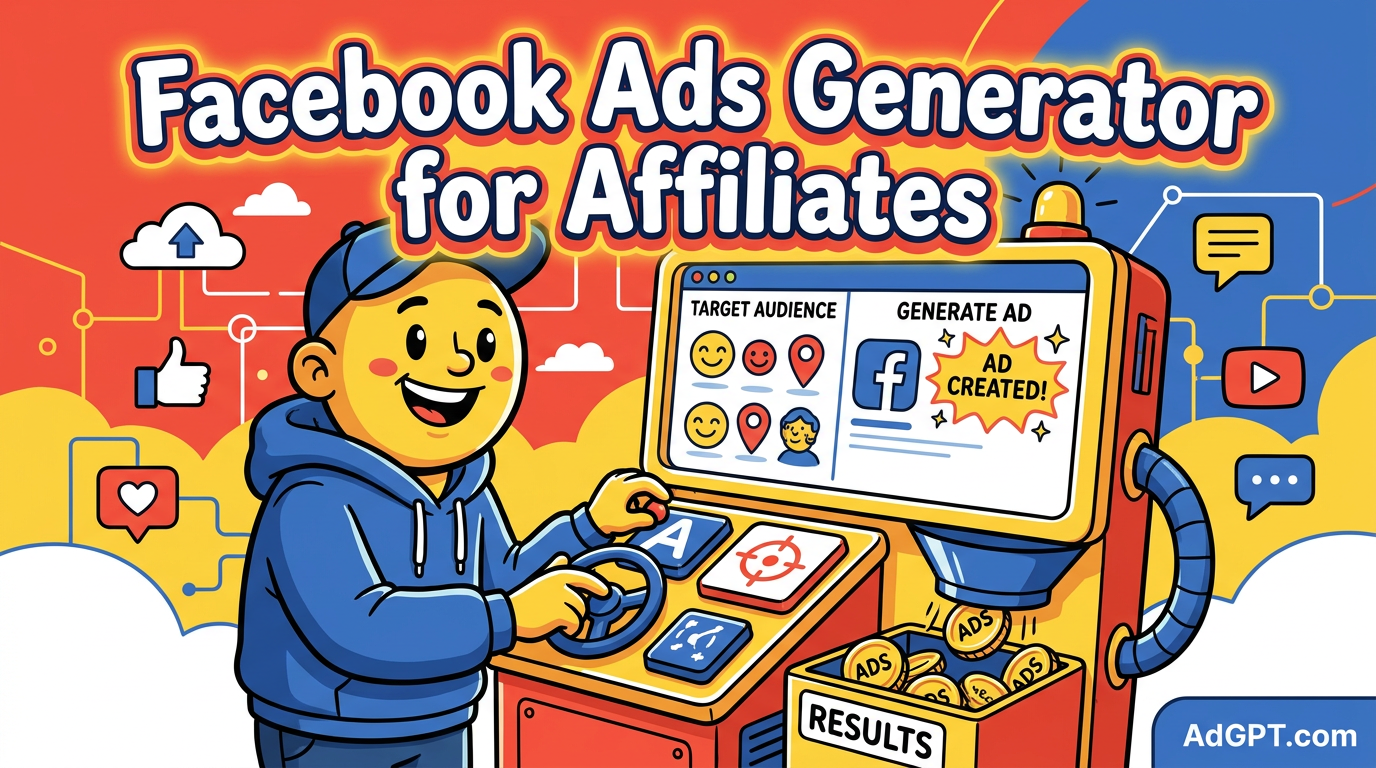
A Facebook ads generator lets affiliate marketers produce dozens of compliant ad variations in minutes, cutting creative costs and reducing the back-and-forth with Meta's compliance review system. For affiliates running nutra, finance, SaaS, or ecommerce offers, speed and policy adherence are the two variables that separate profitable campaigns from paused accounts.
Why Affiliate Marketers Need a Dedicated Facebook Ads Generator
Generic design tools were built for brand teams with unlimited revision cycles. Affiliates operate on a different clock — offer windows close, CPMs shift overnight, and a single creative that trips Meta's automated review can freeze an entire account. A purpose-built Facebook ads generator solves three affiliate-specific problems at once: volume, variation, and policy alignment.
Meta's ad system rewards creative diversity. Advertisers who test five or more unique creatives per ad set see, on average, 20–30% lower CPAs compared to those running one or two static assets. For affiliates paying out of pocket for every click, that gap is the difference between a campaign that scales and one that bleeds budget.
Compliance is the second pressure point. Meta rejected or limited over 2.2 billion ads in 2023 alone, and the pace of automated enforcement has accelerated into 2025. Affiliates promoting health, financial, or relationship offers face the highest disapproval rates. Generating policy-aware copy and creative from the start — rather than editing after rejection — compresses the time from creative brief to live campaign.
What to Look for in a Facebook Ads Generator Built for Affiliates
Not every AI creative tool handles affiliate workflows. Before committing to a platform, evaluate it against the criteria that actually move affiliate metrics.
- Offer-type awareness: The generator should understand nutra, finance, and lead-gen creative conventions — not just DTC product ads.
- Policy guardrails built in: Look for tools that flag before-and-after claims, income guarantees, and superlative language that trigger Meta's automated review.
- Batch output: A single offer needs at minimum five headline variants, three body copy angles, and multiple aspect ratios (1:1, 4:5, 9:16). Manual tools cannot deliver this at affiliate scale.
- Static and video formats: Facebook Feed and Reels require different assets. A generator that handles both from one brief saves hours of reformatting.
- Landing page ingestion: The best tools read your offer URL and extract product claims, USPs, and imagery automatically — no copy-paste brief required.
AdGPT's AI Ads Generator covers all five of these requirements. It ingests an offer URL, applies Meta-compatible copy rules, and exports production-ready assets across formats without requiring a designer or copywriter.
How to Generate High-Volume Compliant Facebook Ads in 5 Steps
- Input your offer URL or landing page. AdGPT scrapes the page for headlines, benefit statements, and product imagery. This eliminates the blank-page problem and grounds the copy in actual offer claims rather than invented ones that could trigger review issues.
- Select your offer vertical. Choose from categories like health and wellness, financial services, software, or ecommerce. The generator applies vertical-specific copy guardrails — for example, avoiding absolute health claims in nutra ads or ROI guarantees in finance creatives.
- Define your audience angle. Input a target persona or pain point (e.g., "35–55, chronic back pain, skeptical of surgery"). The generator produces copy that speaks to that specific awareness level rather than generic benefit-focused language.
- Generate in batch. Request five to ten creative variations per angle. Test hooks that lead with the problem, hooks that lead with the result, and hooks that lead with social proof. Meta's algorithm selects winners faster when it has genuine variety to test.
- Export and resize for all placements. Use the Static Ads Generator to export 1:1 for Feed, 4:5 for Mobile Feed, and 9:16 for Reels — all from the same source creative. Resize in one click rather than rebuilding each format manually.
Facebook Ads Generator: Platform Comparison for Affiliates
The market has several AI creative tools, but they differ significantly on affiliate-relevant features. According to Affiliate Times, compliance automation and batch output are the two features affiliates rank highest when evaluating creative tools in 2025 — ahead of design quality and template variety.
| Feature | AdGPT | Generic AI Design Tools | Manual Freelance |
|---|---|---|---|
| Batch creative output | 10+ per brief | 1–3 per brief | 1–2 per day |
| Policy-aware copy | Yes, vertical-specific | Partial | Depends on writer |
| URL ingestion | Yes | Rare | Manual brief required |
| Multi-format export | Feed, Reels, Stories | Limited | Extra cost per format |
| Cost per 10 creatives | Under $10 | $15–$40 | $150–$500+ |
| Turnaround time | Under 5 minutes | 10–20 minutes | 2–5 business days |
For affiliates running A vs B comparisons across multiple offers or verticals, the ability to generate and test creative in parallel — rather than sequentially — is a structural advantage that compounds over time.
Compliance Tactics That Reduce Facebook Ad Rejections
Creative rejection is not random. Meta's automated review flags specific patterns, and affiliates who understand those patterns can front-load compliance into the generation process rather than patching it after the fact.
- Avoid before-and-after imagery in health and wellness creatives. Meta's computer vision detects these explicitly and flags them for manual review, which adds 24–72 hours to the process.
- Do not use first-person health claims. Phrases like "I lost 30 pounds" in ad copy trigger the personal attributes policy. Reframe as testimonial-style with proper attribution framing.
- Limit financial income claims to verifiable ranges. "Earn up to $500/week" is reviewable; "quit your job tomorrow" is not. Policy-aware generators flag the latter automatically.
- Use benefit language over cure language. "Supports joint comfort" passes where "cures joint pain" does not. This single substitution eliminates the most common nutra rejection reason.
- Rotate creative frequently. Meta's algorithm penalizes ad fatigue, and fatigued creatives often trigger higher scrutiny in review queues. Generating fresh variants every 7–10 days keeps accounts healthier.
The Ecommerce Ad Creator applies many of these rules automatically for product-based affiliate offers, which reduces the manual compliance editing step that eats into affiliate margins.
Scaling Creative Output Without Burning Budget
The economics of affiliate marketing punish slow creative iteration. Every day spent waiting on a freelancer or agency is a day of offer traffic going to competitors with fresher angles. Scaling creative production requires a system, not just a tool.
A practical affiliate creative system looks like this: generate ten variations per offer per week, run each for 3–5 days with a $20–$30 daily budget per variation, kill anything with a CTR below 1.5% on Facebook Feed, and double budget on anything above 2.5%. The generator refills the creative pipeline faster than the testing cycle consumes it — which is the operational goal.
For affiliates who also run YouTube pre-roll alongside Facebook, the workflow covered in YouTube Ads AI: Launch High-ROAS Product Ads Without an Agency shows how to repurpose winning Facebook hooks into video scripts without starting from zero. And for offers where UGC-style creative outperforms polished static ads — which is increasingly common on Facebook Mobile Feed — AI UGC Creator: How to Scale Winning Ads Without Burnout covers the exact production workflow.
The underlying principle is the same: the affiliate who generates and tests the most creative variations, with the lowest per-unit cost, wins the offer. A purpose-built AI Ads Generator is no longer a convenience — it is the operational infrastructure that makes affiliate media buying profitable at scale in 2025 and beyond.
Frequently asked questions
What is a Facebook ads generator and how does it work for affiliates?
How do I make Facebook ads compliant for nutra or finance affiliate offers?
How many Facebook ad variations should an affiliate test per offer?
Can a Facebook ads generator handle multiple placements and aspect ratios?
What is the difference between a static Facebook ad and a video ad for affiliates?
How often should affiliates refresh Facebook ad creative to avoid fatigue?
🤖 Explore this article with AI



Furqan Javed
Get featured in this article
Place your brand in front of thousands of marketers and decision-makers. Pick the articles, add your links and anchor text, and our editors handle the integration — with an answer within 24 hours.
- $200Editorial Mention
- $500Expanded Editorial
- $1,250Featured Placement
We don't do link exchanges or free swaps — placements are paid and subject to editorial review. If a placement isn't approved, it's fully refunded.