Table of contents
- Why Creative Fatigue Is the Biggest Enemy of Ecommerce Ad Performance
- The Core Components of a High-Converting Ecommerce Ad
- Platform-by-Platform Ecommerce Ad Specs and Strategy in 2026
- How to Build an Ecommerce Ad System That Scales
- AI-Generated Ecommerce Ads: What the Data Says About Creative Quality
- Measuring Ecommerce Ad Performance Beyond ROAS
- Getting Started: From Creative Bottleneck to Creative Engine
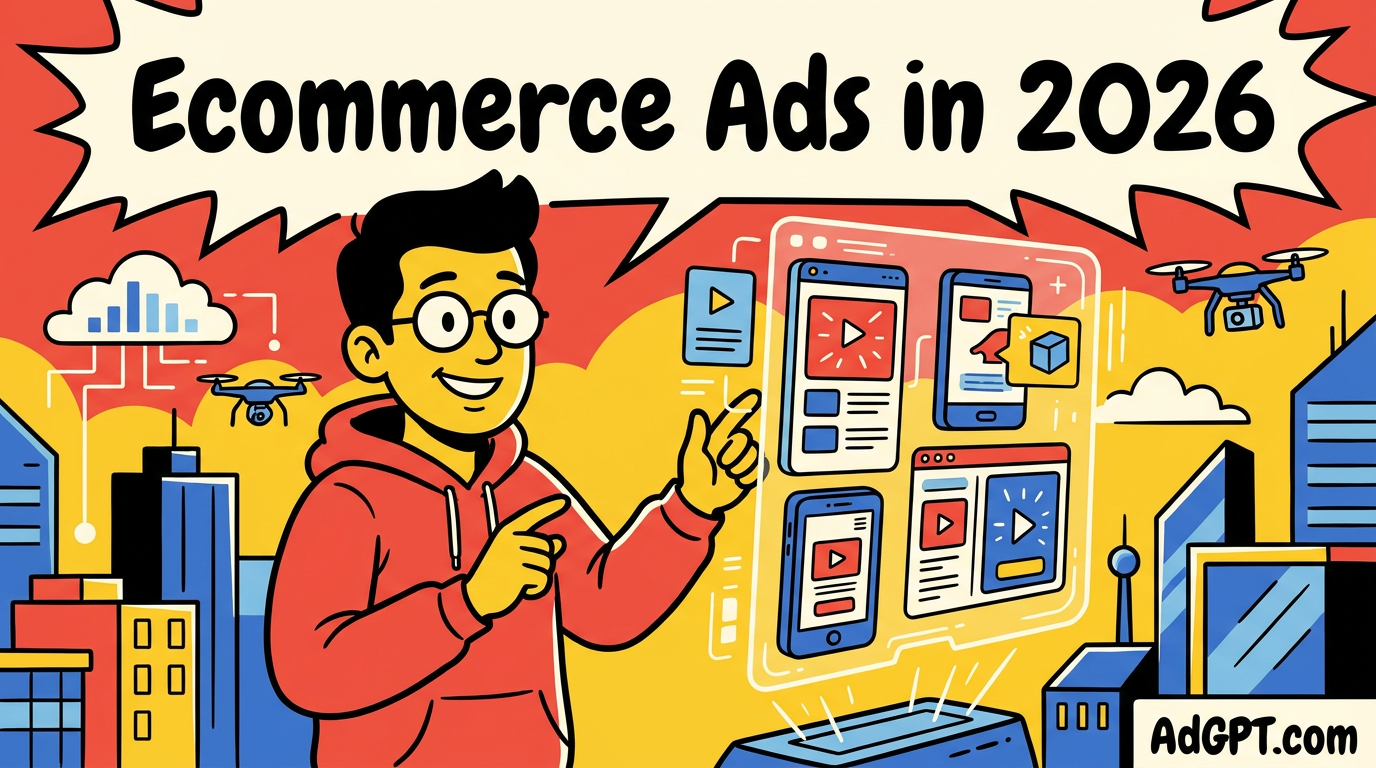
Ecommerce ads live or die on creative velocity. Brands that refresh ad creative every 7–14 days consistently outperform those running the same assets for 30+ days — yet most DTC teams hit a production wall long before they hit their ROAS targets. The solution in 2026 is not a bigger creative team; it is a smarter system.
Why Creative Fatigue Is the Biggest Enemy of Ecommerce Ad Performance
Meta's own data shows that ad frequency above 3.0 correlates with a 15–25% drop in click-through rate on the same audience segment. On TikTok, where content half-lives can be as short as 48 hours, creative fatigue sets in even faster. For DTC brands spending $10,000–$500,000 per month on paid media, stale creative is a direct tax on every dollar of ad spend.
The traditional response — briefing an agency, waiting two weeks, paying $800–$2,000 per video — cannot match the cadence modern platforms demand. In 2026, the brands winning on Meta, TikTok, YouTube, and Google Shopping are those producing 20–50 creative variants per week, not 3–5 per month.
Creative bottleneck manifests in three ways DTC marketers know well: approval queues that outlast trend cycles, a design team pulled in too many directions, and rising CPMs that make each failed ad test increasingly expensive. Average Meta CPMs for ecommerce audiences climbed past $14 in Q1 2026, according to industry benchmarks — meaning a poorly performing creative costs real money fast.
The Core Components of a High-Converting Ecommerce Ad
Before scaling volume, the structure of each ad unit matters. Conversion-focused ecommerce ads share five consistent elements regardless of platform:
- Pattern interrupt in the first 3 seconds: On TikTok and Instagram Reels, 60% of users make a scroll-or-stop decision before the third second. Motion, bold text overlays, or an unexpected visual hook are non-negotiable.
- Single, specific value proposition: Ads that lead with one clear benefit — "Lose 2 inches in 30 days" or "Ships free in 24 hours" — consistently outperform generic brand messaging in direct-response testing.
- Social proof signal: A star rating, review count, or UGC clip placed within the first five seconds raises conversion rates by an average of 18% across ecommerce verticals.
- Visual product clarity: Shoppers cannot buy what they cannot see. High-contrast product shots or close-up demo clips reduce purchase hesitation.
- Friction-free CTA: "Shop Now," "Get Yours," and "Claim Offer" consistently outperform vague calls like "Learn More" for bottom-of-funnel ecommerce campaigns.
Platform-by-Platform Ecommerce Ad Specs and Strategy in 2026
Each platform rewards different creative formats and bidding strategies. The table below summarizes current best practices for DTC brands running paid ecommerce campaigns.
| Platform | Top Format | Ideal Aspect Ratio | Avg. CPM (Q1 2026) | Best Objective |
|---|---|---|---|---|
| Meta (Facebook/Instagram) | Reels + Static Carousel | 9:16 / 1:1 | $14.20 | Purchase / ROAS |
| TikTok | In-Feed Video | 9:16 | $9.80 | Video Shopping Ads |
| YouTube | 6s Bumper + 15s Non-Skip | 16:9 | $11.50 | Awareness + Retarget |
| Google Shopping | Performance Max | Mixed | $7.40 | Conversion Value |
| Single Image + Lead Gen | 1.91:1 | $38.00 | B2B Ecommerce / Wholesale |
The CPM gap between TikTok ($9.80) and LinkedIn ($38.00) illustrates why most DTC brands allocate 60–70% of their ecommerce ad budget to Meta and TikTok, reserving LinkedIn for wholesale or B2B ecommerce plays.
How to Build an Ecommerce Ad System That Scales
Scaling ecommerce ads is not about spending more — it is about testing faster and killing losers earlier. The following process is used by performance marketing teams generating 8-figure annual revenue on paid channels.
- Establish creative pillars: Define 4–6 repeatable messaging angles (e.g., problem/solution, social proof, before/after, price anchor, urgency). Every ad belongs to one pillar, which makes performance data actionable — if "social proof" ads outperform "urgency" ads by 40%, you know where to double down.
- Set a weekly creative output target: Brands spending $30,000+/month need a minimum of 15–20 new creative variants per week to maintain healthy frequency caps. Use an AI Ads Generator to hit that volume without proportionally expanding headcount.
- Run structured A/B tests: Change one variable at a time — hook copy vs. hook visual, CTA color, headline length. Platforms like Meta's Advantage+ Creative and TikTok's Smart Creative automatically surface top performers, but only if the input pool is large enough.
- Implement a 72-hour kill rule: Any ad unit spending above your target CPA threshold for 72 hours without a qualifying conversion gets paused. Emotional attachment to a creative you briefed is expensive.
- Repurpose winners across formats: A static ad that wins on Facebook often translates to a high-ROAS Google Shopping asset. Use an Ecommerce Ad Creator to resize and reformat top performers for every placement in minutes rather than days.
- Feed learnings back into briefs: Document winning hooks, CTAs, and visual styles in a swipe file. Feed these patterns back into your AI generation prompts to compound performance improvements over time.
AI-Generated Ecommerce Ads: What the Data Says About Creative Quality
The hesitation some DTC marketers still carry around AI-generated creative — that it will look generic or off-brand — is increasingly contradicted by performance data. Brands using AI ad tools in 2025–2026 report 30–60% reductions in cost-per-creative alongside flat or improving CTRs compared to agency-produced assets. The reason is counterintuitive: AI-generated volume enables faster iteration, and faster iteration surfaces winning concepts that a slower, higher-cost production model would never have tested.
Static ads remain among the highest-ROI formats for ecommerce, particularly for retargeting. A well-structured Static Ads Generator can produce 50 on-brand variants from a single product image in under ten minutes — a task that would consume a full design day in a traditional workflow.
For brands running affiliate programs alongside their paid media, the velocity advantage compounds further. Affiliates need on-brand creative assets quickly, and AI generation lets brand teams supply compliant, tested assets at scale. As Affiliate Times reporting on creator-led affiliate strategies has noted, the brands with the fastest creative supply chains are capturing disproportionate affiliate revenue in competitive ecommerce categories. AdGPT's own guide to AI ad creative for affiliate marketers covers the compliance and volume considerations in depth.
The Facebook Ads Generator use case is particularly strong for DTC brands: Meta's algorithm rewards creative diversity, and accounts uploading 10+ variants per ad set see lower auction competition and better delivery efficiency than accounts running 2–3 assets.
Measuring Ecommerce Ad Performance Beyond ROAS
ROAS is a lagging indicator. By the time ROAS drops, creative fatigue has already been eroding your funnel for days. The metrics that predict ROAS decline before it shows up in your dashboard are:
- Frequency: When frequency on a cold audience exceeds 2.5 within a 7-day window, begin rotating new creative immediately.
- Hook rate (3-second video views ÷ impressions): A hook rate below 25% on TikTok or Meta Reels signals the opening frame is not stopping the scroll. This is a creative problem, not a targeting problem.
- Hold rate (ThruPlay ÷ 3-second views): If viewers start watching but drop before 50% of the video, the body of the ad is losing them. Tighten the value proposition delivery.
- CPM trend: A rising CPM on a stable audience often means your creative relevance score is declining. Fresh creative resets relevance and frequently brings CPMs back down 10–20%.
- Add-to-cart rate: A healthy ecommerce ad drives a 3–6% add-to-cart rate from paid traffic. Below 2% usually points to a mismatch between ad promise and landing page delivery.
Connecting these signals to your creative calendar — not just your media plan — is what separates performance marketing teams from ad-spend teams. For a deeper look at how AI tools are reshaping affiliate and performance creative workflows, the AdGPT blog post on AI video ads for affiliate marketers provides additional context on compliant creative at scale.
Getting Started: From Creative Bottleneck to Creative Engine
The shift from a bottlenecked creative operation to a scalable ad engine does not require a budget overhaul. It requires a system change. DTC brands that have made this transition share a common pattern: they stopped treating creative production as a project and started treating it as a continuous manufacturing process — with inputs (product assets, copy angles, audience insights), throughput (AI generation, rapid review), and outputs (live ad variants, performance data).
The practical starting point is generating a full set of platform-ready ecommerce ad variants from existing product imagery and proven copy angles. AdGPT's AI Ads Generator handles Meta, TikTok, YouTube, and Google placements simultaneously, cutting the production cycle from weeks to hours. For DTC brands managing multiple SKUs or seasonal campaigns, that speed differential is the margin between hitting Q-peak revenue targets and watching competitors capture the spend.
Frequently asked questions
How often should DTC brands refresh their ecommerce ad creative?
What is the best ad format for ecommerce brands on Meta in 2026?
How many ad creative variants should an ecommerce brand test per week?
Can AI-generated ads match the quality of agency-produced ecommerce creative?
What metrics indicate ecommerce ad creative fatigue before ROAS declines?
Which platforms have the lowest CPMs for ecommerce ads in 2026?
🤖 Explore this article with AI



Furqan Javed
Get featured in this article
Place your brand in front of thousands of marketers and decision-makers. Pick the articles, add your links and anchor text, and our editors handle the integration — with an answer within 24 hours.
- $200Editorial Mention
- $500Expanded Editorial
- $1,250Featured Placement
We don't do link exchanges or free swaps — placements are paid and subject to editorial review. If a placement isn't approved, it's fully refunded.