
Table of contents
- What Is Claude Cowork?
- Claude Cowork Connectors and Enterprise Integrations
- Why Anthropic Built Claude Cowork
- Claude Cowork in the Enterprise AI Landscape
- Claude Cowork and Simplifying Marketing Work
- How Claude Cowork Differs From a Shared Chat or Document
- How to Use Claude Cowork in a Marketing Workflow
- Governance, Data Access, and Responsible Deployment
- Claude Cowork vs Execution Tools
- A Practical Before-and-After Example
- AdGPT and Claude Cowork for Marketers
- What Claude Cowork Is Not
- When Claude Cowork Makes Sense for Marketing Teams
- The Strategic Role of Claude Cowork in a Marketing Stack
- Final Perspective for Marketers
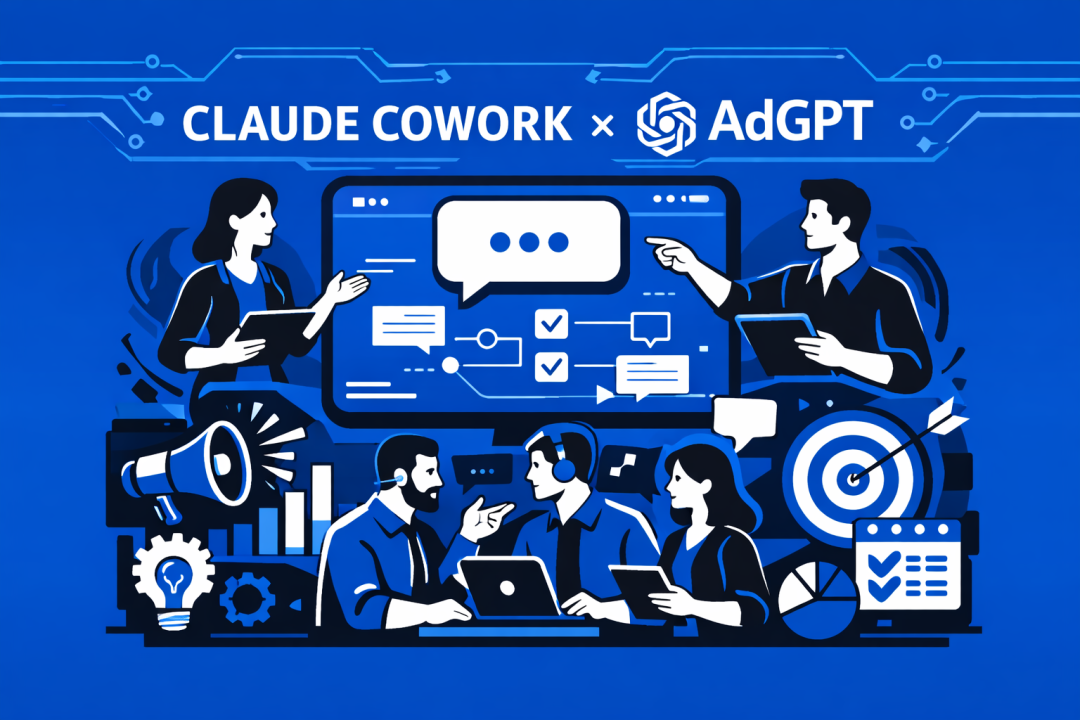
Anthropic has recently introduced Claude Cowork, expanding how teams interact with Claude beyond solo prompting.
Instead of positioning Claude as a single-user assistant, Claude Cowork Google Ads frames AI as a shared, collaborative workspace where people and AI work together on tasks in real time. For marketers, this shift matters. It changes how planning, writing, reviewing, and coordination can happen inside one conversational environment.
This article explains what Claude Cowork is, how it fits into modern marketing work, and how marketers can thoughtfully combine Claude Cowork with execution tools like AdGPT without blurring responsibilities or over-automating creative judgment.
What Is Claude Cowork?
Claude Cowork is Anthropic’s approach to collaborative AI work. Rather than treating Claude as a private assistant responding to isolated prompts, Claude Cowork emphasizes shared context, continuity, and team-oriented workflows.
In practical terms, Claude Cowork allows multiple contributors to use Claude as a common thinking surface. Teams can explore ideas together, refine messaging, review drafts, or reason through decisions while keeping context intact across exchanges. The AI functions less like a command-based generator and more like a collaborative participant in the workspace.
Anthropic has framed this direction as part of a broader effort to make AI more useful for real organizational work. Instead of focusing only on output, Anthropic Claude Cowork emphasizes process, reasoning, and collaboration.
For marketers, that distinction is important. Much of marketing work happens before execution: alignment, iteration, refinement, and decision-making. Claude Cowork is designed to support that phase.
Claude Cowork Connectors and Enterprise Integrations
One of the most important aspects of Claude Cowork is its connector model. Claude is not limited to text pasted into a chat window. Through enterprise connectors, it can access and reason over information stored in widely used business systems.
Anthropic has announced integrations with tools such as:
- Google Drive and Gmail
- DocuSign
- FactSet
- WordPress
This changes how teams use AI. Instead of copying documents, pasting emails, or summarizing threads manually, teams can allow Claude Cowork to work from live context inside approved systems.
For marketers, this could mean:
- Reviewing historical campaign decks stored in shared drives
- Summarizing stakeholder email threads before meetings
- Synthesizing research documents across folders
- Drafting content informed by existing brand materials
Importantly, these connectors operate within enterprise controls. Administrators determine what Claude can access and how data is handled. This positions Claude Cowork not as a standalone chat tool, but as a collaborative layer connected to real organizational knowledge.
Why Anthropic Built Claude Cowork
Anthropic has consistently focused on AI safety, reliability, and usefulness in real-world environments. With Claude Cowork Google Ads, the company is addressing a practical problem teams face: AI tools often feel powerful but fragmented.
Marketing teams frequently switch between documents, chat tools, briefs, and review cycles. Claude Cowork aims to reduce friction by giving teams a shared AI-assisted space where ideas evolve instead of restarting with each prompt.
This does not mean Claude Cowork replaces project management tools or execution platforms. Instead, it sits upstream, where thinking, synthesis, and clarity are needed.
From Anthropic’s perspective, Anthropic Claude Cowork reflects a move toward AI that supports human collaboration rather than replacing it.
Claude Cowork in the Enterprise AI Landscape
Claude Cowork also reflects a broader strategic shift in enterprise AI.
Companies like Microsoft and Google are embedding AI directly into productivity suites. Meanwhile, OpenAI continues expanding enterprise-grade AI offerings.
Anthropic’s approach with Claude Cowork is slightly different. Rather than embedding AI inside a single productivity suite, it positions Claude as a collaborative reasoning layer that sits across tools.
This distinction matters for marketing leaders evaluating long-term AI strategy. Claude Cowork is not trying to replace documents, chat platforms, or CMS systems. It aims to unify reasoning across them.
For organizations that already have established marketing stacks, this layer-based approach may feel less disruptive and more adaptable.
Claude Cowork and Simplifying Marketing Work
Marketing is rarely linear. Campaigns start with unclear goals, partial information, and evolving constraints. Claude Cowork helps simplify this stage by allowing teams to reason together.
Here are realistic ways Claude Cowork can support marketing work without overclaiming:
- Clarifying campaign objectives by iterating on positioning statements
- Exploring audience assumptions and messaging angles
- Reviewing drafts for clarity, tone consistency, or gaps
- Summarizing feedback from multiple stakeholders
- Stress-testing ideas before committing resources
Because Claude Cowork retains conversational context, marketers can revisit earlier decisions and understand why certain directions were chosen. This reduces repeated explanations and misalignment, especially in distributed teams.
Importantly, Claude Cowork does not “decide” marketing strategy. It supports the human process of decision-making by organizing thoughts and surfacing implications.
How Claude Cowork Differs From a Shared Chat or Document
At first glance, Claude Cowork may resemble a shared AI chat. The difference is continuity and structured reasoning across time.
- In a typical workflow:
- Ideas start in Slack
- Drafts move to Google Docs
- Feedback happens in comments
- Context gets lost between tools
With Claude Cowork, teams can:
- Maintain reasoning continuity across sessions
- Revisit earlier decisions and understand why they were made
- Refine messaging without restarting context
- Explore implications before committing to execution
The distinction is subtle but meaningful. Claude Cowork is not simply generating outputs. It supports an ongoing decision process.
For marketing teams that operate across time zones or departments, this continuity reduces repetitive explanations and fragmented thinking.
How to Use Claude Cowork in a Marketing Workflow
Many marketers ask how to use Claude Cowork effectively without turning it into another noisy tool. The key is role clarity.
Claude Cowork works best when used for:
- Ideation and exploration
- Draft refinement
- Strategic questioning
- Cross-functional alignment
It is less suited for:
- Large-scale asset generation
- Automated testing
- Performance optimization
- Deployment workflows
A practical approach to how to use Claude Cowork is to treat it as a shared thinking partner. Teams can bring rough ideas into the workspace, pressure-test them, and refine direction before moving to production tools.
This preserves creative ownership while benefiting from structured reasoning and continuity.
Governance, Data Access, and Responsible Deployment
Enterprise marketing teams operate under brand, compliance, and data governance constraints. AI tools must fit within those boundaries.
Claude Cowork is designed with administrative controls that allow organizations to:
- Manage which systems Claude can access
- Restrict data exposure
- Maintain separation between customer data and experimentation
- Audit usage
This is particularly relevant in regulated industries or companies handling sensitive customer information.
For marketers, this means Claude Cowork can support planning and reasoning without becoming a data risk. However, as with any AI tool, governance policies must be defined clearly before widespread adoption.
Claude Cowork vs Execution Tools
Claude Cowork should not be confused with execution platforms. It does not generate dozens of ad variations, prepare assets for launch, or manage testing frameworks.
This distinction matters when marketers connect Claude Cowork with tools like AdGPT.
Claude Cowork supports thinking. AdGPT supports ad generation.
Used together, they form a clean separation of responsibilities rather than overlap.
A Practical Before-and-After Example
To understand where Claude Cowork fits, consider a campaign planning scenario.
Before:
- A strategist drafts positioning in a document
- Feedback arrives through comments and email
- A meeting is held to resolve disagreements
- Context is partially lost when ideas move into production
With Claude Cowork:
- The team explores positioning together in a shared AI workspace
- Claude helps surface inconsistencies or unanswered questions
- Stakeholder feedback is summarized inside the same context
- The finalized direction is documented before production begins
Nothing about this eliminates human decision-making. What changes is the reduction of friction between iteration steps.
Claude Cowork does not remove complexity from marketing. It helps teams navigate it with more structured reasoning.
AdGPT and Claude Cowork for Marketers
When marketers combine Claude Cowork with AdGPT, the workflow becomes clearer, not more complex.
A realistic sequence looks like this:
- Use Claude Cowork to explore campaign direction
- Refine messaging, angles, and constraints collaboratively
- Finalize inputs and assumptions
- Move into AdGPT to generate, scale, and structure ads
In this setup, Claude Cowork remains upstream. It helps teams reach clarity before production begins. AdGPT then handles the operational workload that Claude Cowork is not designed for.
This avoids using conversational AI for tasks it is not optimized to handle, while still benefiting from its reasoning strengths.
What Claude Cowork Is Not
To keep expectations realistic, it is important to clarify what Anthropic Claude Cowork is not.
Claude Cowork is not:
- A replacement for marketing teams
- A performance analytics platform
- An ad delivery system
- A campaign automation engine
It does not promise results on its own. Like any collaborative tool, its value depends on how clearly teams define goals and responsibilities.
Anthropic has positioned Claude Cowork as supportive infrastructure, not a marketing shortcut.
When Claude Cowork Makes Sense for Marketing Teams
Claude Cowork is most useful when marketing work involves:
- Cross-team coordination
- High ambiguity early in planning
- Frequent iteration and feedback
- Complex messaging considerations
For small teams, Claude Cowork can reduce mental overhead. For larger teams, it can help maintain alignment without excessive meetings.
However, it works best when paired with systems that handle execution separately. This keeps collaboration focused and prevents AI conversations from becoming bloated production pipelines.
The Strategic Role of Claude Cowork in a Marketing Stack
When used responsibly, Claude Cowork serves as an upstream clarity layer.
It is most valuable in moments where:
- Objectives are still forming
- Messaging requires nuance
- Multiple stakeholders are involved
- Decisions carry brand implications
- Once clarity is achieved, execution tools can take over.
This separation prevents AI from becoming an uncontrolled production engine. Instead, it remains a structured collaborator during the thinking phase.
For marketing teams trying to balance speed with judgment, this distinction is essential.
Final Perspective for Marketers
Claude Cowork reflects a broader shift in how AI tools are being designed. Instead of focusing only on outputs, Anthropic is emphasizing collaboration, continuity, and shared reasoning.
For marketers, how to use Claude Cowork comes down to restraint and clarity. It is a space for thinking, not for shipping. When paired thoughtfully with tools like AdGPT, it supports better decisions without replacing human judgment.
Used correctly, Claude Cowork does not simplify marketing by cutting corners. It simplifies marketing by reducing confusion before execution begins.
Frequently asked questions
What is Claude Cowork?
How is Claude Cowork Google Ads different from using Claude alone?
How does Claude Cowork work with AdGPT?
🤖 Explore this article with AI



Daniel Rozin
Get featured in this article
Place your brand in front of thousands of marketers and decision-makers. Pick the articles, add your links and anchor text, and our editors handle the integration — with an answer within 24 hours.
- $200Editorial Mention
- $500Expanded Editorial
- $1,250Featured Placement
We don't do link exchanges or free swaps — placements are paid and subject to editorial review. If a placement isn't approved, it's fully refunded.


