
Table of contents
- Why Creative Fatigue Is Killing DTC Ad Performance
- What AI Video Ad Generators Actually Do
- Platform-by-Platform: Where AI Video Ads Perform Best
- How to Build an AI Video Ad Pipeline: Step-by-Step
- Integrating AI Video Ads with Your Broader Ecommerce Creative Stack
- Measuring What Matters: AI Video Ad KPIs for DTC
- Getting Started: From Zero to First AI Video Ad
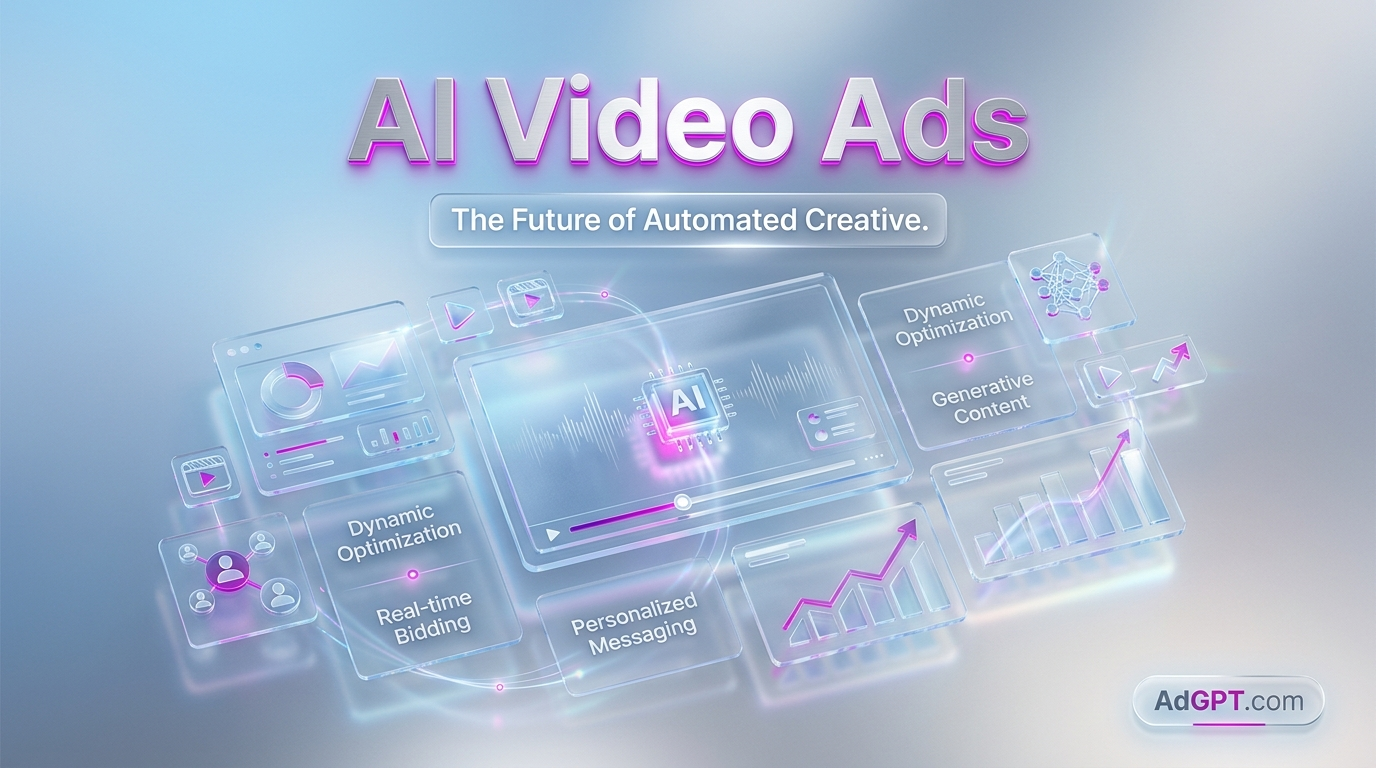
AI video ads are machine-generated video creatives produced in minutes rather than days, enabling DTC brands to test more concepts, combat creative fatigue, and scale paid media budgets without hiring larger production teams. In 2026, brands running AI-generated video ads on Meta and TikTok are reporting up to 40% lower cost-per-click versus manually produced creative — because they can iterate faster and retire underperforming assets before CPMs erode margin.
Why Creative Fatigue Is Killing DTC Ad Performance
Creative fatigue occurs when an audience has seen the same ad enough times that click-through rates drop and CPMs rise. Meta's own internal data showed that ad frequency above 3.5 within a seven-day window can reduce conversion rates by more than 20%. For DTC brands running always-on campaigns, that threshold arrives fast — sometimes within 72 hours of launching a new creative.
The traditional fix is to rotate new creative into the ad set. The problem: a single 30-second video ad, properly produced with a freelancer or agency, costs between $800 and $5,000 and takes five to ten business days. At that production velocity, most brands can afford to test two or three concepts per month. That is not enough rotation to stay ahead of fatigue on a platform delivering millions of impressions daily.
AI video ad tools collapse that timeline from days to minutes and that cost from thousands of dollars to a fraction of a monthly software subscription. The result is a creative pipeline that can produce ten, twenty, or fifty variants in the same time it used to take to produce one.
What AI Video Ad Generators Actually Do
Modern AI video ad platforms are not simple slideshow builders. They use large language models to generate scripts, text-to-speech or synthetic voiceover to narrate them, diffusion models or stock-video APIs to populate visual sequences, and layout engines trained on high-performing ad templates to assemble the final output. Some tools also accept a product URL or a raw product image and generate a full video from scratch.
Key capabilities to look for in 2026:
- URL-to-video generation: Paste a product page URL and receive a ready-to-export video ad in under five minutes.
- Multi-platform resizing: Automatic reformatting for 9:16 (TikTok, Reels), 1:1 (Facebook Feed), and 16:9 (YouTube pre-roll) from a single source file.
- Hook variation testing: Generate five to ten opening-second variants to A/B test stop-scroll performance without re-producing the full ad.
- UGC-style output: Synthetic creator-style videos that mimic authentic user-generated content, which consistently outperforms polished brand creative on TikTok.
- Brand-kit consistency: Logo, color palette, and font rules applied automatically so every variant stays on brand.
The AI Video Ad Creator from AdGPT covers all five of these capabilities, making it a practical production layer for performance marketing teams that need volume without sacrificing brand control.
Platform-by-Platform: Where AI Video Ads Perform Best
Not every platform rewards the same creative format. The table below maps platform context to the video ad specifications and AI-generation approaches that drive results in 2026.
| Platform | Best Format | Optimal Length | AI Creative Priority | Avg. CPM Range (2026) |
|---|---|---|---|---|
| Meta (Facebook & Instagram) | 9:16 Reels, 1:1 Feed | 15–30 seconds | Hook variation, social-proof overlays | $8–$18 |
| TikTok | 9:16 native vertical | 9–21 seconds | UGC-style, fast-cut, text overlays | $5–$12 |
| YouTube | 16:9 pre-roll, 9:16 Shorts | 15 seconds (skippable), 6 seconds (bumper) | Problem-solution narrative, product demo | $10–$25 |
| 16:9 in-feed | 30–60 seconds | Authority framing, testimonial-style | $45–$90 | |
| 2:3 vertical | 6–15 seconds | Lifestyle visual, minimal text | $4–$10 |
As Online Store News notes in its coverage of Shopify-native ad stacks, merchants who unify their creative production across these five platforms inside a single AI tool see faster go-to-market times and more consistent brand presence than those managing platform-specific workflows separately.
How to Build an AI Video Ad Pipeline: Step-by-Step
The following workflow applies to any DTC brand running paid media on at least two platforms simultaneously. It is designed to produce a minimum of ten distinct video ad variants per week without adding headcount.
- Audit your current creative library. Use an ad analysis tool to identify which existing video ads have the highest thumb-stop rate, hook retention at three seconds, and click-through rate. These become your control creatives and your creative brief benchmarks. The Ad Analysis Tool guide for DTC brands covers this audit process in detail.
- Define your variant matrix. For each winning concept, map out the axes you want to test: hook style (question vs. bold claim vs. statistic), visual treatment (product close-up vs. lifestyle vs. UGC), and call-to-action copy (Shop Now vs. Get 20% Off vs. Try Risk-Free). A 3×3×3 matrix produces 27 variants from one core concept.
- Input your product data into the AI generator. Paste your product URL or upload product images, enter your brand kit, and select the target platform and aspect ratio. The AI Ads Generator ingests this data and produces a first batch of video ads in under ten minutes.
- Export and resize for each platform. A single source video should be resized to 9:16, 1:1, and 16:9 without re-generating the entire asset. AI resizing tools handle this automatically, preserving focal points and text legibility across formats.
- Launch in a structured creative testing campaign. On Meta, use a Campaign Budget Optimization setup with one ad set per audience segment and three to five video variants per ad set. Let the algorithm allocate spend for 72 hours before reading results. On TikTok, use Spark Ads or standard in-feed placements with a separate campaign for each hook variant.
- Retire and replace on a rolling cadence. Any creative with a frequency above 3.0 or a CTR decline of more than 15% week-over-week should be retired and replaced within 48 hours. With an AI video pipeline, replacement creative is ready before the performance drop becomes a budget problem.
Integrating AI Video Ads with Your Broader Ecommerce Creative Stack
Video ads do not operate in isolation. High-performing DTC brands in 2026 run video as the top-of-funnel awareness driver and pair it with static creative for retargeting, where shorter attention spans and purchase intent are higher. The Ecommerce Ad Creator handles both formats inside the same interface, so creative teams are not toggling between multiple tools when building a full-funnel campaign.
For Facebook-specific campaigns, the Facebook Ads Generator includes placement-specific templates that account for the algorithmic differences between Facebook Feed, Instagram Reels, and Audience Network placements — nuances that generic video editors ignore and that directly affect Quality Ranking scores inside Meta Ads Manager.
Seasonal campaign planning also benefits from an AI video pipeline. Brands that pre-generate creative libraries for Q4 events — Black Friday, Cyber Monday, holiday gifting — are able to launch faster and capture early-buyer intent before CPMs spike. The Black Friday sale schedule planning guide outlines the specific timeline for pre-loading creative assets so campaigns go live the moment bidding windows open.
Measuring What Matters: AI Video Ad KPIs for DTC
Vanity metrics like impressions and reach tell you very little about whether an AI-generated video ad is working. The KPIs that determine whether to scale or kill a creative are:
- Three-second video view rate: The percentage of people who watch past the first three seconds. Benchmark: above 25% on Meta, above 20% on TikTok.
- Hook-to-hold ratio: Three-second views divided by ThruPlays (15-second completion). A ratio above 2.5 indicates a strong hook but weak body copy — a clear signal to iterate on the middle of the script, not the opening.
- Cost per initiated checkout (CPIC): More meaningful than CPC for DTC because it connects video engagement directly to purchase intent. Target varies by average order value, but a CPIC below 15% of AOV is a general threshold for a scalable creative.
- Creative fatigue score: Frequency divided by CTR decay rate over a seven-day rolling window. Any score above 1.8 triggers automatic creative rotation in a well-managed pipeline.
- Incremental ROAS by creative variant: Using Meta's Conversion Lift or TikTok's Attribution Analytics to isolate the true revenue contribution of each video variant, not just last-click attribution.
Tracking these metrics consistently across every AI-generated video ad is what separates brands that scale profitably from those that burn budget on creative that looked good in the thumbnail but never converted at volume.
Getting Started: From Zero to First AI Video Ad
For DTC marketers who have not yet integrated AI video into their paid media workflow, the entry point is simpler than it appears. There is no need to overhaul an existing tech stack or retrain a creative team. Start by identifying the single highest-traffic product in your catalog, gather five product images, and paste the product URL into the AI Ads Generator. Within minutes, a set of platform-ready video ads will be available to download, review, and push directly to Meta or TikTok Ads Manager. The first test does not need to be perfect — it needs to generate data. That data becomes the foundation of a systematic creative strategy that compounds over time.
Frequently asked questions
What are AI video ads and how do they work?
How much do AI video ads cost compared to traditional video production?
Which platforms benefit most from AI-generated video ads?
Can AI video ads replace UGC or influencer creative?
How many AI video ad variants should a DTC brand test per month?
What metrics should I track to evaluate AI video ad performance?
🤖 Explore this article with AI



Tal Yeger
Get featured in this article
Place your brand in front of thousands of marketers and decision-makers. Pick the articles, add your links and anchor text, and our editors handle the integration — with an answer within 24 hours.
- $200Editorial Mention
- $500Expanded Editorial
- $1,250Featured Placement
We don't do link exchanges or free swaps — placements are paid and subject to editorial review. If a placement isn't approved, it's fully refunded.


