
Table of contents
- Why Creative Fatigue Is Killing DTC Paid Media Performance
- What AI Video Ads Actually Are (and What They Are Not)
- Platform-by-Platform: Where AI Video Ads Perform Best in 2026
- How to Build an AI Video Ad in Five Steps
- The Cost Equation: AI Video Ads vs. Traditional Production
- Common Mistakes DTC Brands Make With AI Video Ads
- Choosing the Right AI Video Ad Tool for Your DTC Stack
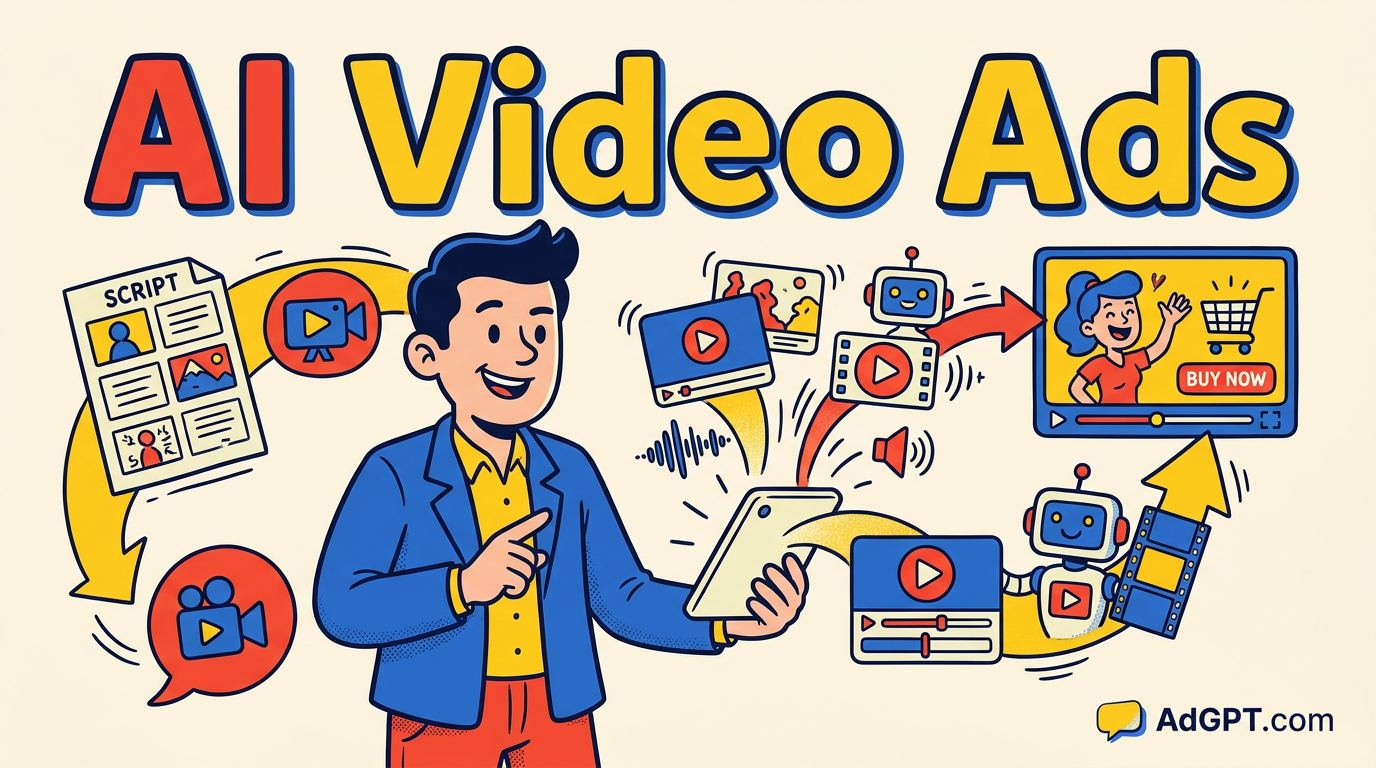
AI video ads let DTC marketers generate scroll-stopping video creative in minutes instead of weeks — no production crew, no creative agency retainer, and no bottleneck between ideation and launch. For brands fighting rising CPMs and creative exhaustion across Meta, TikTok, and YouTube, this shift is no longer optional; it is the competitive baseline for 2026.
Why Creative Fatigue Is Killing DTC Paid Media Performance
Creative fatigue occurs when an audience sees the same ad too many times and engagement drops — click-through rates fall, cost-per-click rises, and return on ad spend collapses. Meta's own internal data has shown that ad frequency above 3.4 impressions per week triggers measurable CTR decline. For DTC brands running always-on campaigns, that threshold arrives fast.
The traditional fix — briefing a video production studio, waiting two to three weeks for assets, then testing a handful of variants — cannot keep pace with algorithmic demand. TikTok recommends refreshing creative every seven days for brands running performance campaigns. YouTube's own best-practice guidance calls for at least five to eight creative variants per campaign to allow proper A/B signal. Most DTC teams, operating with lean in-house creative functions, cannot produce at that velocity manually.
The result is predictable: CPMs climb, ROAS compresses, and media buyers end up pausing spend on their best-performing campaigns simply because they have run out of fresh creative. Leveraging AI to revolutionize advertising is no longer a future-state ambition — it is what separates scaling brands from stalling ones right now.
What AI Video Ads Actually Are (and What They Are Not)
AI video ads are short-form or mid-form video advertisements generated — fully or in part — by artificial intelligence. Inputs typically include a product URL, a brand brief, a script prompt, or existing static assets. Outputs include motion graphics, voiceover narration, on-screen text overlays, scene transitions, and platform-optimized aspect ratios.
AI video generation is not a magic button that replaces brand strategy. The output quality is directly proportional to the quality of the brief fed into the system. Strong hooks, clear value propositions, and defined audience personas still matter. What AI eliminates is the expensive, slow production layer that sits between a good idea and a live ad.
Key capabilities available in mature AI video ad platforms in 2026 include:
- Script-to-video generation from a text prompt or product description
- URL ingestion — the tool scrapes a product page and builds creative automatically
- AI-generated or licensed stock footage spliced with brand assets
- Synthetic voiceover in dozens of languages and tones
- Automatic resizing for 9:16, 1:1, 16:9, and 4:5 formats
- UGC-style video that mimics authentic creator content without a creator
AdGPT's AI Video Ad Creator covers all of these use cases in a single workflow, removing the need to stitch together four different SaaS tools for one deliverable.
Platform-by-Platform: Where AI Video Ads Perform Best in 2026
Different platforms reward different video formats, lengths, and creative styles. The table below maps the key variables DTC marketers need to match creative output to platform expectations.
| Platform | Recommended Length | Best Format | Hook Window | AI Video Priority |
|---|---|---|---|---|
| Meta (Facebook/Instagram Reels) | 15–30 seconds | 9:16 vertical | First 3 seconds | High — volume and variant testing |
| TikTok | 9–15 seconds (performance), up to 60s (brand) | 9:16 vertical, native feel | First 2 seconds | Very High — UGC-style essential |
| YouTube (Shorts + Pre-roll) | 6–15 seconds (Shorts), 15–30s (pre-roll) | 9:16 and 16:9 | First 5 seconds | High — dual format demand |
| 15–30 seconds | 1:1 or 16:9 | First 3 seconds | Medium — B2B product demos | |
| 6–15 seconds | 2:3 or 1:1 | First 2 seconds | Medium — lifestyle and product focus |
Meta remains the highest-volume testing environment for most DTC brands, which is why a purpose-built Facebook Ads Generator that understands Meta's creative specs accelerates time-to-launch significantly.
How to Build an AI Video Ad in Five Steps
The following workflow applies to any DTC brand launching video creative for a performance campaign. Each step assumes the use of an AI-native ad creation platform rather than a traditional video editor.
- Define the creative brief. Specify the product, primary audience segment, key benefit, and the single action you want the viewer to take. Vague inputs produce vague outputs. A brief as short as three sentences outperforms an empty prompt every time.
- Input your product URL or assets. Modern AI ad tools can ingest a product page URL and extract imagery, copy, pricing, and brand tone automatically. This eliminates the manual upload stage and keeps creative aligned with live product data. AdGPT's Ecommerce Ad Creator is built specifically for this workflow.
- Select format, length, and platform. Choose the platform destination before generating. A TikTok ad and a YouTube pre-roll ad serving the same product need different hooks, pacing, and aspect ratios. Generating for the wrong format wastes testing budget.
- Generate multiple variants simultaneously. Run at least three to five creative variants per campaign from the same brief — varying the hook, the voiceover tone, or the opening visual. This is where AI creates asymmetric leverage: five variants in minutes versus five variants in five weeks.
- Launch, measure, and iterate weekly. Push variants live, monitor hook rate (the percentage of viewers who watch past the three-second mark) and hold rate (viewers who complete 50% or more of the video). Kill underperformers at day three. Double spend on winners. Feed winning patterns back into your next brief cycle.
As USA Business Times has documented in coverage of US small business technology adoption, AI-powered creative tools are among the fastest-growing software categories for growth-stage consumer brands, driven directly by the economics of paid social performance marketing.
The Cost Equation: AI Video Ads vs. Traditional Production
The financial case for AI video ads is straightforward when the numbers are laid out. A single professionally produced 30-second video ad — with scripting, filming, and editing — costs between $3,000 and $15,000 depending on the production house and talent involved. Turnaround runs two to four weeks. A single asset gives a media buyer one creative to test.
An AI video ad generation workflow at scale produces 10 to 20 unique video variants for a fraction of that cost, often under $100 per asset at volume, with turnaround measured in hours. For a DTC brand spending $20,000 per month on paid media across Meta and TikTok, the creative refresh rate required to maintain sub-$25 CPMs demands a production volume that traditional methods cannot support at any reasonable budget.
The AI Ads Generator from AdGPT is built to close exactly this gap — giving performance marketers the creative volume, variant depth, and platform alignment needed to sustain efficient spend without ballooning production overhead.
Common Mistakes DTC Brands Make With AI Video Ads
Adopting AI video generation does not automatically solve creative performance problems. Several patterns consistently limit results for brands new to this workflow:
- Weak hooks: The first two to three seconds determine whether a viewer scrolls past or watches. AI can generate the visual and audio, but the hook concept — a bold claim, a surprising visual, a direct address — must come from strategic creative thinking.
- Single-variant launches: Generating one AI video and treating it as a production win defeats the purpose. The value of AI is volume and iteration. Launching a single asset is a production mindset applied to an AI tool.
- Ignoring platform audio norms: TikTok ads perform significantly better with trending audio or energetic voiceover. LinkedIn video often plays muted, requiring subtitles to carry the message. AI tools that generate platform-agnostic audio without adjustment will underperform.
- No brand guardrails: Without defined brand fonts, color palettes, and tone guidelines fed into the system, AI-generated creative can drift from brand identity and erode long-term recognition even while driving short-term conversions.
For a broader look at how AI is changing the paid advertising landscape beyond video formats alone, the post on leveraging AI to revolutionize advertising covers the full strategic picture.
Choosing the Right AI Video Ad Tool for Your DTC Stack
Not all AI video ad generators are built for performance marketing. Some are optimized for brand awareness video at the expense of direct-response mechanics. Evaluation criteria that matter for DTC paid media teams include: native platform format support (9:16 output without manual cropping), direct URL-to-video ingestion, variant volume per session, voiceover language coverage, and integration with ad account libraries for direct export.
AdGPT scores well across all five dimensions and is purpose-built for the performance marketing context — not general video creation. The distinction matters because a tool designed for organic social content will produce creative that looks native to a feed but lacks the structured hook-benefit-CTA architecture that direct-response video requires to convert.
DTC brands managing Shopify storefronts with active Meta and TikTok campaigns will find the most immediate ROI by starting with the AI Ads Generator, running a 10-variant test batch against their current best-performing creative, and measuring hook rate improvement within the first 72 hours of spend.
Frequently asked questions
What are AI video ads and how do they differ from traditional video ads?
How much do AI video ads cost compared to professionally produced video ads?
Which platforms benefit most from AI-generated video ads?
How many video ad variants should a DTC brand generate per campaign?
Can AI video ads replace human creative strategy?
What metrics should DTC marketers track for AI video ad performance?
🤖 Explore this article with AI



Daniel Rozin
Get featured in this article
Place your brand in front of thousands of marketers and decision-makers. Pick the articles, add your links and anchor text, and our editors handle the integration — with an answer within 24 hours.
- $200Editorial Mention
- $500Expanded Editorial
- $1,250Featured Placement
We don't do link exchanges or free swaps — placements are paid and subject to editorial review. If a placement isn't approved, it's fully refunded.


