
Table of contents
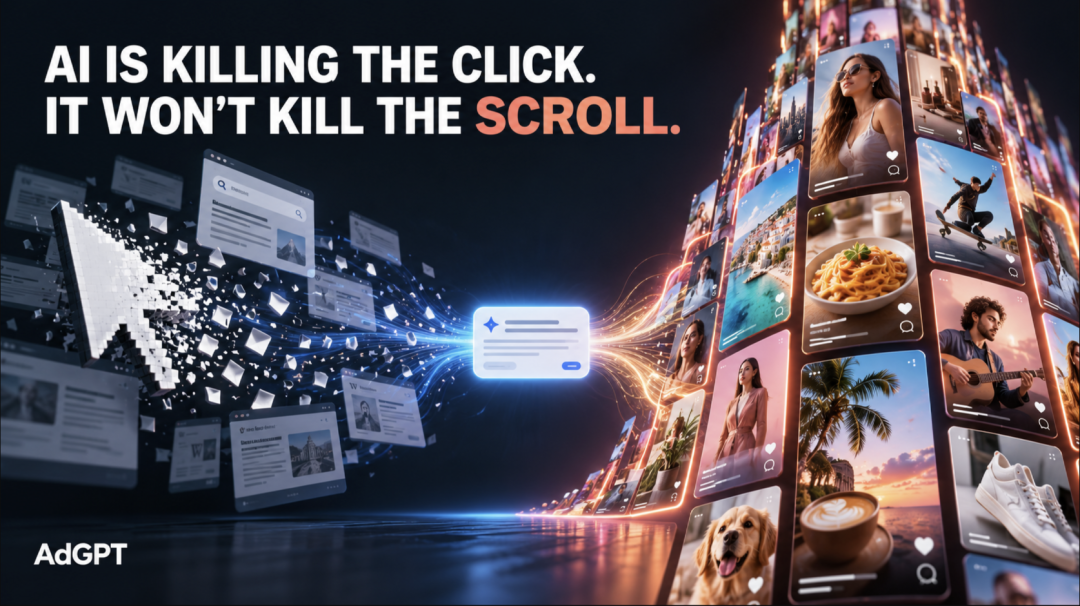
AI Is Killing the Click. It Won’t Kill the Scroll.
Why AI may weaken the open web while making Meta, TikTok and YouTube even more important to advertisers.
By AdGPT
For two decades, digital advertising was built around a relatively simple behavior: people moved around the internet.
They searched. They clicked. They visited news sites. They read reviews. They opened articles. They jumped from Google to publishers, from publishers to brands, and from brands to stores.
Every one of those movements created advertising inventory.
Generative AI is beginning to break that journey.
Ask an AI engine what happened in the markets today, which laptop to buy, what a new piece of legislation means, or why your flight was cancelled, and increasingly you may get what you need without visiting ten websites — or even one.
The information comes to you.
That sounds like a change in search.
We believe it is much bigger than that.
It is a change in the architecture of digital attention — and therefore in the architecture of advertising.
And it creates a fascinating paradox:
AI may reduce our need to visit information destinations. But it does not eliminate our desire to visit attention destinations.
That distinction could define the next decade of advertising.
The internet has two very different kinds of destinations
For years we treated websites, search engines, social networks and video platforms as parts of roughly the same digital ecosystem.
But psychologically, they perform very different jobs.
Consider a news website.
Most visits begin with some form of information intent:
**What happened?
Why did it happen?
What does it mean?**
Now consider TikTok, Instagram, Facebook or YouTube.
Very often, there is no specific question.
You open the app.
You scroll.
You watch.
You discover something you weren't looking for.
You see what people are talking about. You watch someone argue. You discover a product. You laugh. You become angry. You see a celebrity. You learn something. You send something to a friend.
And then you scroll again.
This leads to a distinction that marketers should start taking seriously:
AI is becoming an Information Layer.
Social is becoming the Attention Layer.
And those two layers behave very differently.
AI is extraordinarily good at eliminating unnecessary journeys
Generative AI is fundamentally a compression technology for information.
Previously:
Question → Search → Results → Click → Website → Read → Answer
Increasingly:
Question → AI → Answer
Sometimes the user will still click through. Often there are excellent reasons to do so: original reporting, deeper analysis, first-hand expertise, shopping, community, video or verification.
But the requirement to click is weakening.
Similarweb has reported that organic traffic to news websites fell 26% following the introduction of Google's AI Overviews, while news-related queries to ChatGPT rose sharply. At the same time, referrals from ChatGPT to publishers have grown substantially — evidence that AI is not simply destroying traffic but creating a new and very different discovery channel.
Google disputes the broader idea that AI Search is collapsing web traffic. The company says total organic click volume from Google Search has remained relatively stable year over year and argues that clicks generated after AI results are, on average, higher quality. Google does acknowledge, however, that for simple questions users may obtain what they need directly from the AI response without clicking further.
Both observations can be true.
AI does not need to destroy the web to fundamentally change its economics.
It only needs to remove a meaningful percentage of the clicks that previously occurred because users had no easier way to obtain an answer.
And the scale is becoming enormous. In 2026, Google reported more than 2.5 billion monthly active users for AI Overviews and more than one billion for AI Mode.
The destination is slowly moving upstream.
The answer is becoming the interface.
But AI has a much harder time replacing the scroll
This is where the future becomes particularly interesting for advertisers.
People don't open TikTok only because they need information.
They open it because they don't know what they are about to see.
That uncertainty is part of the product.
The same is true of Instagram Reels, Facebook feeds and YouTube.
There is entertainment.
There is curiosity.
There is social validation.
There is aspiration.
There is outrage.
There is voyeurism.
There is community.
There is discovery.
And above all, there is the infinite possibility that the next thing might be more interesting than the thing currently on the screen.
An AI answer solves intent.
A feed manufactures discovery.
That distinction matters enormously.
The numbers are beginning to show it
The Reuters Institute's Digital News Report 2026 documented a remarkable milestone.
Across 48 markets, 54% of respondents now use social media and video networks for news, compared with 51% who use news organizations' websites and apps.
For the first time, social and video platforms have moved ahead.
Even more revealing is what is happening with video.
Reuters reports that 77% of respondents consume online news video every week.
But the growth isn't primarily happening on publishers' own properties.
Consumption of video on news websites and apps actually declined, while third-party video platforms continued to gain importance. YouTube, Instagram and TikTok are increasingly becoming the places where audiences encounter video — including video produced by traditional publishers.
In other words:
Content may survive while the destination changes.
That is an extraordinarily important distinction for advertisers.
The great advertising migration may be from destinations to environments
The first era of digital advertising was built around websites.
The second was built around search and social platforms.
The third may be built around two giant environments:
The Attention Environment
Meta. TikTok. YouTube. Creators. Feeds. Reels. Shorts. Video.
Places people enter to spend time.
The Intent Environment
AI assistants. AI Search. AI recommendations. Conversational commerce.
Places people enter because they want something answered, solved, compared, recommended or purchased.
The advertising opportunity exists in both.
But the creative logic is completely different.
In the Attention Environment, the advertiser must interrupt.
In the Intent Environment, the advertiser must become relevant to the answer.
That changes almost everything.
Follow the advertising money
The advertising market is already signaling where attention is moving.
According to IAB/PwC, U.S. internet advertising revenue reached a record $294.6 billion in 2025, up 13.9% year over year. Digital video was the fastest-growing major format, increasing 25.4%.
IAB separately estimated U.S. digital video advertising at approximately $72 billion in 2025, after 18% growth the previous year. Digital video was expected to represent nearly 60% of all U.S. TV/video advertising expenditure — versus only 29% in 2020.
This doesn't mean search disappears.
It doesn't mean publishers disappear.
And it certainly doesn't mean every advertising dollar moves to social video.
It means something subtler:
The scarce commodity in advertising is becoming less about access to information and increasingly about access to attention.
Meta and TikTok understand exactly what is happening
Look at where the platforms themselves are investing.
Meta says it is increasingly using AI to determine which advertisement and creative will resonate with each individual. In early 2026, the company said the revenue run-rate associated with its video-generation advertising tools had reached $10 billion.
TikTok is moving in essentially the same direction.
Its Smart+ system increasingly automates targeting, bidding and creative selection, while Symphony uses generative AI to help advertisers produce creative specifically for the TikTok environment.
This suggests that another transformation is happening simultaneously.
AI isn't only changing where advertising appears.
AI is changing how advertising gets made, tested, selected and optimized.
This is the world AdGPT was built for
The traditional advertising workflow was designed for an era of limited creative production.
A team developed a concept.
Designers created a handful of ads.
A media buyer launched them.
Everyone waited for results.
Then the process started again.
That model becomes increasingly incompatible with algorithmic media.
When Meta, TikTok, YouTube, Google and emerging AI advertising environments can evaluate enormous numbers of signals continuously, the advertiser needs something fundamentally different:
more creative, more formats, more variations, faster learning and faster iteration — without sacrificing the coherence of the campaign.
That is the problem AdGPT.com is designed to solve.
AdGPT approaches advertising not as the generation of a single ad, but as the generation of a Full Campaign.
One strategy can become video, UGC, short-form creative, static ads, search advertising, conversational ads and editorial content — giving performance marketers a larger creative surface from which algorithms can learn.
But generating more ads is only the first step.
The larger opportunity is to connect the entire performance cycle:
Create → Launch → Measure → Optimize → Learn → Create Again.
That is where advertising is heading.
Not toward one perfect ad.
Toward an intelligent system capable of producing and learning continuously.
The death of the destination does not mean the death of the publisher
There is one more consequence that may be easy to miss.
Publishers may lose traffic while simultaneously gaining a new kind of importance.
AI engines need sources.
They need reporting.
They need expert opinions.
They need authoritative information.
They need entities they can understand, associate and cite.
So the publisher's value may gradually move from:
How many people visited my page?
toward:
How much influence does my information have on what machines tell people?
This is a fundamentally different economy.
Traffic was the currency of the search era.
Authority may become one of the currencies of the AI era.
Google itself is now adding more mechanisms intended to expose original websites and sources within AI responses, including inline links, previews and preferred sources.
So publishers aren't necessarily disappearing.
Their role is being rewritten.
Advertising now has three battles to win
For marketers, all of this can be reduced to a surprisingly simple framework.
WIN THE FEED.
Capture attention where people spend time.
Meta. TikTok. YouTube. Reels. Shorts. Creators.
This requires creative volume, speed, experimentation and constant iteration.
WIN THE ANSWER.
Make the brand understandable, authoritative and relevant to the AI systems increasingly mediating discovery and decision-making.
This requires content, authority, structured knowledge, citations, credible third-party signals and a new discipline of AI visibility.
WIN THE SALE.
Connect attention and intent to measurable business outcomes.
This requires performance data, experimentation, optimization and a continuous learning loop.
These are no longer three separate marketing problems.
They are becoming one system.
AI kills the click. It doesn't kill the scroll.
That may be the simplest way to understand what is happening.
AI is extraordinarily good at compressing information.
It can summarize ten articles.
Compare ten products.
Explain an event.
Answer the follow-up question.
And increasingly it can do all of this without requiring the user to travel across the web.
But humans have not stopped being humans.
We still want to watch.
Discover.
Laugh.
Argue.
Follow.
Share.
Compare ourselves with other people.
See what everyone else is talking about.
And occasionally buy something we had absolutely no intention of buying five minutes earlier.
That is why the rise of AI may not weaken the giant social platforms.
It may make their most valuable asset even clearer.
They own attention.
AI increasingly owns answers.
And the next generation of advertising technology will need to understand how to win in both worlds.
That is the advertising world AdGPT is being built for.
AdGPT. GO WIN.
🤖 Explore this article with AI



Eilon Zarmon
Get featured in this article
Place your brand in front of thousands of marketers and decision-makers. Pick the articles, add your links and anchor text, and our editors handle the integration — with an answer within 24 hours.
- $200Editorial Mention
- $500Expanded Editorial
- $1,250Featured Placement
We don't do link exchanges or free swaps — placements are paid and subject to editorial review. If a placement isn't approved, it's fully refunded.


