
Table of contents
- Why Creative Fatigue Is the Real Growth Ceiling for DTC Brands
- What an AI Ad Generator Actually Does
- Platform-by-Platform: Where AI-Generated Ads Perform Best in 2026
- How to Build a High-Velocity Creative System With an AI Ad Generator
- Ecommerce-Specific Advantages: Why DTC Brands Get Outsized ROI
- Choosing the Right AI Ad Generator: What to Evaluate
- From Creative Bottleneck to Creative Engine
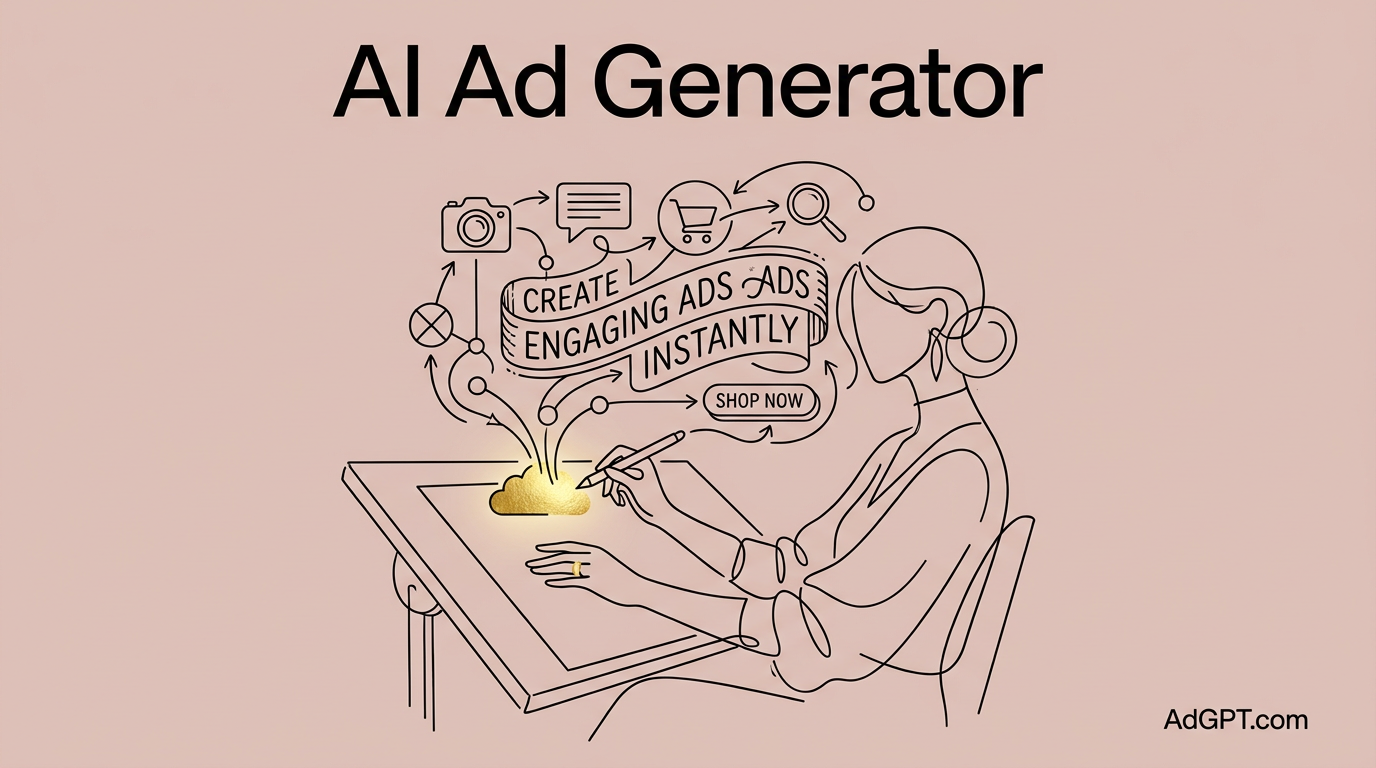
An AI ad generator is software that uses large language models and generative image or video models to produce ready-to-launch ad creatives — copy, visuals, and format variants — in minutes rather than days. For DTC brand marketers battling rising CPMs and a constant demand for fresh creative, it is the fastest path from product to paid media at scale.
Why Creative Fatigue Is the Real Growth Ceiling for DTC Brands
Meta's own data shows that creative is responsible for 56% of a campaign's conversion outcome — more than audience targeting or bid strategy. Yet the average Meta ad set sees audience-level saturation within 7–14 days of launch. When a creative tires, CPMs climb, click-through rates fall, and return on ad spend collapses — even if the product and offer are unchanged.
For a DTC brand spending $30,000 per month on paid social, a 20% CPM increase driven by creative fatigue translates to roughly $6,000 in wasted budget monthly. The bottleneck is rarely strategy — it is the inability to produce enough high-quality creative variants to stay ahead of the algorithm's appetite for novelty.
Traditional production pipelines (briefing, design, copywriting, revision, export, resize) can take 3–5 business days per asset. An AI ad generator compresses that to under ten minutes per variant, giving performance teams the creative velocity they need to test, iterate, and scale.
What an AI Ad Generator Actually Does
Modern AI ad generators are not simple template tools. They combine several AI capabilities into a single workflow:
- Copy generation: The model reads your product URL, brand guidelines, or a short brief and writes headlines, primary text, and CTAs optimized for each platform's character limits and tone conventions.
- Visual generation: Diffusion models create product-forward imagery or lifestyle scenes without requiring a photoshoot. Some tools also pull existing product images and enhance them for ad contexts.
- Format adaptation: A single concept is automatically resized and reformatted for Meta feed (1:1), Stories (9:16), YouTube pre-roll (16:9), and TikTok (9:16) — eliminating the tedious resize loop.
- Video production: Advanced generators assemble short-form video ads with motion, voiceover, captions, and hooks tailored to platform-specific best practices.
- Performance analysis: Some platforms score creatives before launch, flagging weak hooks or low predicted CTR so teams can iterate before spending a dollar.
AdGPT's AI Ads Generator covers all five layers — from static images to full video campaigns — inside one dashboard, removing the need to stitch together four different SaaS tools.
Platform-by-Platform: Where AI-Generated Ads Perform Best in 2026
Not every platform rewards the same creative format. The table below maps platform characteristics to the AI generation capabilities DTC brands should prioritize.
| Platform | Dominant Format | Avg. CPM (2026 est.) | Creative Refresh Rate | Key AI Capability Needed |
|---|---|---|---|---|
| Meta (Facebook & Instagram) | Static image, Reels | $12–$18 | Every 7–10 days | Bulk static variants + copy testing |
| TikTok | Native-feel video (9:16) | $8–$14 | Every 5–7 days | UGC-style video generation, strong hooks |
| YouTube | Skippable pre-roll (16:9) | $6–$10 | Every 14–21 days | Long-form video with 5-second hook |
| Single image, carousel | $50–$90 | Every 21–30 days | Professional copy variants, carousel build | |
| Vertical static (2:3) | $2–$6 | Every 14–28 days | Product image enhancement, SEO copy |
For DTC brands, Meta and TikTok demand the highest creative velocity. An Facebook Ads Generator that outputs a dozen copy-visual combinations in one session — rather than one at a time — is not a convenience; it is a competitive requirement.
How to Build a High-Velocity Creative System With an AI Ad Generator
Creative velocity is not about producing more random content — it is a structured system. Follow these steps to build one around an AI ad generator.
- Audit your current creative library. Identify which angles (problem-solution, social proof, before/after, feature demo) are already proven winners in your account. These become your AI generation briefs.
- Set a weekly creative quota. High-performing DTC accounts on Meta run 10–20 active creative variants per ad set. Define how many net-new assets you need each week to maintain that rotation.
- Generate static variants first. Static images are the fastest to produce and the easiest to A/B test. Use AdGPT's Static Ads Generator to produce 8–12 variants per angle in one session, changing headline, color, and CTA systematically.
- Layer in video for top performers. Once a static angle proves a strong CTR (above 1.5% on Meta feed), convert it into a 15–30 second video ad. AI video tools can animate the static concept, add product voiceover, and add captions automatically.
- Resize for every active placement. Never let a winning creative run in only one placement. An AI resize tool converts your 1:1 Meta image into a 9:16 Story and a 16:9 YouTube thumbnail in seconds.
- Schedule weekly creative reviews. Pull performance data every Monday. Flag assets below your CPM or CPA threshold. Feed winning copy angles back into the AI generator as new briefs for the next cycle.
- Document your creative learnings. Build a shared sheet tracking which angles, formats, and hooks correlated with lower CPA. This institutional knowledge makes each AI generation cycle smarter than the last.
Ecommerce-Specific Advantages: Why DTC Brands Get Outsized ROI
AI ad generators deliver higher ROI for ecommerce and DTC brands than for most other advertiser categories, for three structural reasons.
1. High SKU count means high creative demand. A Shopify store with 50 products theoretically needs creative for every product, every season, and every promotional event. Manual production cannot scale to that demand without a large in-house team or a costly agency retainer. An Ecommerce Ad Creator powered by AI can generate product-level creative variants on demand, triggered by a URL or product feed.
2. Performance feedback loops are tight. DTC brands see ROAS data within 24–72 hours of launch. That speed rewards teams who can act on data fast — spinning up new creative in response to what the algorithm signals. AI generation closes the gap between insight and new asset.
3. CPM pressure is structural, not cyclical. As Ecommerce Times has documented through its ongoing coverage of online retail trends, platform ad inventory is growing more competitive every quarter as more DTC brands shift budgets from Google to paid social. Brands that generate more creative iterations per dollar of production cost hold a durable cost advantage.
For a deeper look at how leading DTC brands have restructured their creative operations, see Ecommerce Ads in 2026: How DTC Brands Beat Creative Fatigue — a detailed breakdown of winning playbooks from brands scaling on Meta and TikTok this year.
Choosing the Right AI Ad Generator: What to Evaluate
Not all AI ad generators are built for performance marketing. Evaluate tools against these criteria before committing budget or workflow:
- Output quality on first generation: Does the tool produce launch-ready creative, or does every output require significant manual editing? Test with your actual product before subscribing.
- Format coverage: Confirm the tool supports every placement you actively buy — including vertical video for TikTok and Reels, not just square statics for Facebook feed.
- Brand controls: Can you lock in your brand fonts, color hex codes, and tone-of-voice guidelines so outputs are consistently on-brand without manual correction?
- Speed at volume: How long does it take to generate 20 variants? Tools that take 30 seconds per asset are meaningfully slower at scale than tools that batch-generate.
- Integration with ad platforms: Direct publish to Meta Ads Manager or TikTok Ads Manager eliminates a manual step and reduces the chance of spec errors on upload.
- Pricing transparency: Understand whether you pay per generated asset, per seat, or per monthly credit. For teams generating 100+ assets per month, per-asset pricing compounds quickly.
For brands already running creative fatigue tests in 2026, the supplementary read Ad Creative AI: How DTC Brands Beat Creative Fatigue in 2026 provides a framework for measuring creative saturation and knowing exactly when to rotate new AI-generated assets into your active rotation.
From Creative Bottleneck to Creative Engine
Creative fatigue is a solvable problem — but only if the solution matches the speed at which paid media algorithms consume content. A human-only production team, no matter how talented, cannot generate and test creative variants fast enough to stay ahead of a $30,000-per-month Meta budget in 2026. An AI ad generator does not replace creative judgment; it removes the production bottleneck so that judgment can be applied to strategy, not execution.
The DTC brands gaining share on Meta, TikTok, and YouTube this year are not outspending competitors on production — they are outpacing them on iteration. With the right AI-powered workflow, a two-person performance team can operate with the creative output of an agency, at a fraction of the cost and with full control over quality and brand consistency.
Start building that workflow with AdGPT's AI Ads Generator — designed specifically for performance marketers who need creative volume without sacrificing conversion quality.
Frequently asked questions
What is an AI ad generator and how does it work?
How many ad creative variants should a DTC brand produce per week?
Can an AI ad generator produce creatives for TikTok and Meta in the same session?
Will AI-generated ads perform as well as human-designed ads?
How do I prevent AI-generated ads from looking generic or off-brand?
What is the biggest mistake DTC brands make when adopting an AI ad generator?
🤖 Explore this article with AI



Dudi Rali
Get featured in this article
Place your brand in front of thousands of marketers and decision-makers. Pick the articles, add your links and anchor text, and our editors handle the integration — with an answer within 24 hours.
- $200Editorial Mention
- $500Expanded Editorial
- $1,250Featured Placement
We don't do link exchanges or free swaps — placements are paid and subject to editorial review. If a placement isn't approved, it's fully refunded.


