
Table of contents
- Why Enterprise Brands Are Accelerating AI Creative Adoption
- The Brand Safety Problem With AI-Generated Ads
- Building a Governed AI Creative Workflow: Step-by-Step
- Platform-Specific Considerations for Enterprise AI Creative
- Stakeholder Approval: The Hidden Bottleneck AI Cannot Solve Alone
- Measuring the ROI of Enterprise AI Creative Programs
- Getting Started: Practical First Steps for Enterprise Teams
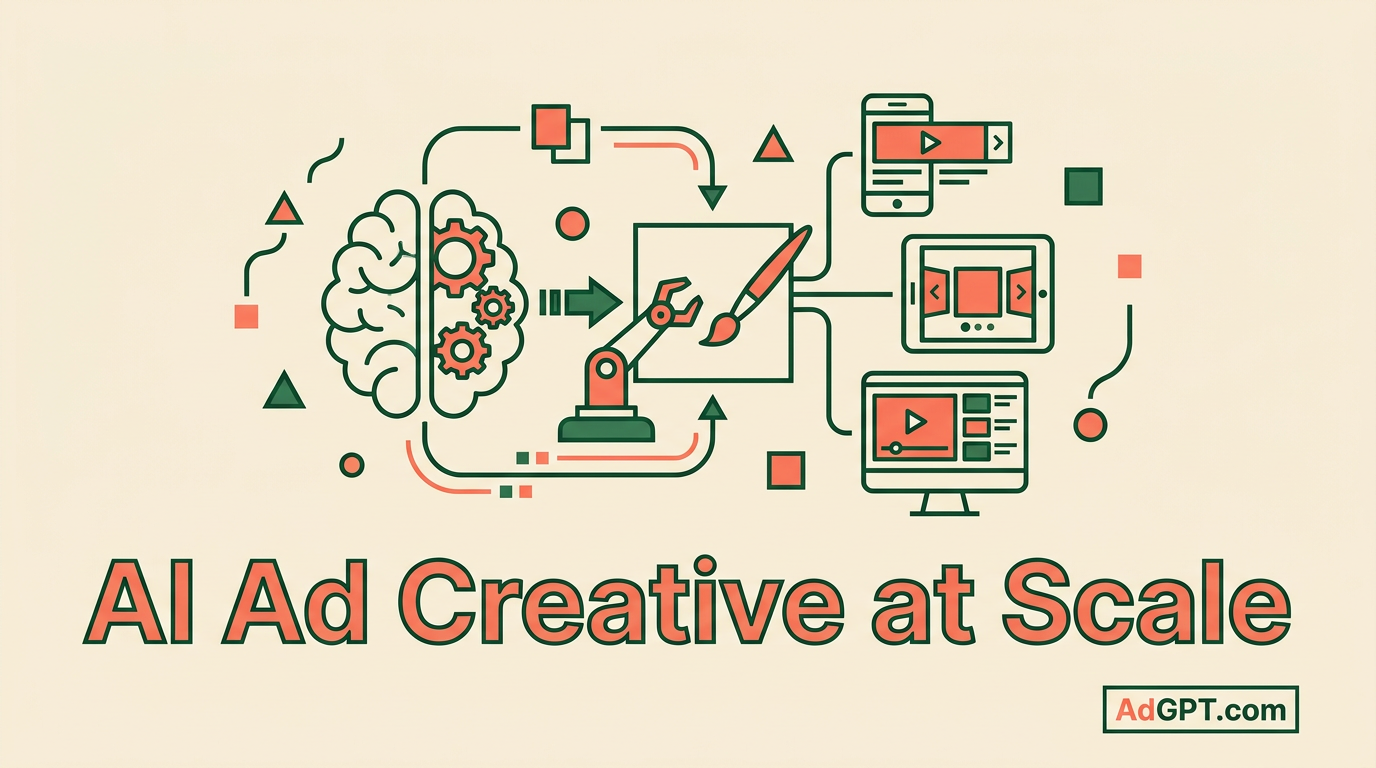
AI ad creative is no longer a pilot-program curiosity — it is the production infrastructure that enterprise marketing teams are adopting in 2026 to ship hundreds of on-brand ad variants across Meta, TikTok, YouTube, and LinkedIn without proportionally scaling headcount. The challenge is not capability; it is governance. This guide explains how to operationalize AI-generated creative at enterprise scale while protecting brand integrity and accelerating stakeholder sign-off.
Why Enterprise Brands Are Accelerating AI Creative Adoption
Creative is now the primary performance lever in paid media. Meta's own advertising research attributes roughly 70 percent of campaign performance variance to the creative itself, not audience targeting or bid strategy. Yet the average enterprise brand team takes 12–18 business days to move a single concept from brief to live ad — a cycle that is structurally incompatible with the speed of algorithmic auctions that reward fresh creative weekly.
AI ad creative platforms compress that cycle dramatically. Teams using automated generation workflows report cutting production time by 60–80 percent per asset, according to multiple agency case studies published in late 2024. The calculus for enterprise is straightforward: more creative iterations tested per quarter equals more data, faster learning, and lower cost-per-acquisition over time.
As USA Business Times has documented in its coverage of US market and technology adoption trends, mid-to-large businesses are reallocating creative production budgets from traditional studio retainers toward AI tooling at an accelerating rate heading into 2026.
The Brand Safety Problem With AI-Generated Ads
Speed without guardrails is the fastest way to erode brand equity. Enterprise marketing leads consistently cite three failure modes when AI creative goes wrong at scale:
- Off-brand visual identity: AI systems that have not been trained on proprietary brand guidelines produce color palettes, typefaces, and imagery that technically function as ads but do not look like the brand.
- Unsafe or ambiguous copy: Language models generating ad headlines can produce claims that are legally unverified, culturally tone-deaf in specific markets, or inconsistent with regulated-industry disclosure requirements.
- Platform policy violations: Each platform — Meta, TikTok, Google, LinkedIn — maintains distinct prohibited content policies. An AI system unaware of these rules can generate assets flagged at review, wasting production time and risking account health.
None of these risks are arguments against AI creative. They are arguments for structured AI creative workflows with brand controls baked in at the generation layer, not bolted on afterward.
Building a Governed AI Creative Workflow: Step-by-Step
Operationalizing AI ad creative inside an enterprise requires a workflow that satisfies both speed and compliance. The following process is used by high-volume brand teams managing $1M+ in monthly ad spend across multiple channels.
- Establish a Brand Intelligence Layer: Before generating a single ad, upload your brand style guide, approved imagery library, tone-of-voice documentation, and legal copy guidelines into the AI platform. Platforms like AdGPT's AI Ads Generator allow brand parameters to constrain outputs at the model level, reducing off-brand drift from the first generation.
- Define Creative Briefs by Campaign Tier: Not all campaigns require equal stakeholder scrutiny. Segment campaigns into Tier 1 (brand campaigns requiring legal and executive review), Tier 2 (performance campaigns requiring channel manager review), and Tier 3 (evergreen or retargeting assets that can run on marketing-only approval). AI creative accelerates Tiers 2 and 3 most immediately.
- Generate Variant Batches, Not Single Executions: AI's advantage is volume. Brief the system to produce 10–20 variants per concept across formats — static, video, and UGC-style — so reviewers evaluate a slate rather than a single execution. This shifts approval meetings from creative debates to selection decisions, which are faster.
- Run Automated Pre-Screening: Before human review, route generated assets through platform policy checkers and internal brand compliance scripts. Eliminate disqualified assets automatically, so stakeholders only review pre-qualified work. Some teams integrate AI ad analysis tools to score creative against historical performance benchmarks before routing for approval.
- Implement a Tiered Approval SLA: Define and enforce time-bound approval windows: 48 hours for Tier 1, 24 hours for Tier 2, 4 hours for Tier 3. Without SLAs, creative still stalls in review regardless of how fast it was produced. AI creative's value is only realized when the downstream process matches the upstream speed.
- Feed Performance Data Back Into the Brief: After assets run, route CTR, conversion rate, and frequency data back into the creative brief template. Over time, this creates a self-improving brief framework where AI inputs are calibrated to the brand's actual performance signals — not generic best practices.
Platform-Specific Considerations for Enterprise AI Creative
Enterprise brands rarely run on a single channel. The creative and compliance requirements vary significantly across platforms, and AI generation workflows must account for these differences.
| Platform | Primary Format Priority | Key Brand Safety Risk | AI Creative Consideration |
|---|---|---|---|
| Meta (Facebook/Instagram) | Reels, Stories, Feed Static | Prohibited content categories; sensitive topics policy | Use Facebook Ads Generator with Meta-specific format templates |
| TikTok | In-Feed Video, TopView | Community guidelines; influencer/UGC authenticity rules | Generate native-style video with sound-on hooks in first 3 seconds |
| YouTube | 6-sec Bumpers, 15–30 sec Pre-Roll | Ad-serving restrictions on sensitive content verticals | Ensure brand safe contextual alignment in video scripts |
| Single Image, Thought Leadership Ads | Professional tone requirements; B2B claim accuracy | AI copy must match verified product/service claims | |
| Google Display | Responsive Display Ads | Landing page quality score; misleading ad policy | Match AI-generated headline variants to landing page copy |
Stakeholder Approval: The Hidden Bottleneck AI Cannot Solve Alone
Even with perfect brand-safe AI outputs, approval cycles kill velocity. Enterprise marketing leads report that legal, brand, and executive reviewers are the most common cause of creative delays — and AI tools that generate 200 assets in an hour are useless if those assets sit in a shared drive for two weeks waiting for sign-off.
The solution is process redesign, not more AI. Specifically:
- Shift legal review upstream: Work with legal to pre-approve a library of claim types, offer structures, and disclaimer language. AI copy generation then draws from this approved library, eliminating per-asset legal review for standard executions.
- Use AI analysis tools to build stakeholder confidence: Presenting creative alongside performance prediction scores — showing why a given variant is likely to outperform — converts subjective approval conversations into data-informed decisions. Stakeholders who trust the system approve faster.
- Create a visual brand library that reviewers have already signed off on: When AI generates visuals from a pre-approved image and style library, reviewers are evaluating composition and message, not re-litigating brand identity. This eliminates the most common objection category in creative review.
Enterprise ecommerce teams that have adopted this approach — combining AI generation with structured approval architecture — have documented approval cycle reductions of 40–60 percent while maintaining or improving brand consistency scores in quarterly audits. The Ecommerce Ad Creator is built with this kind of structured production workflow in mind, supporting multi-format output from a single brief.
Measuring the ROI of Enterprise AI Creative Programs
Enterprise marketing leads need to report upward. The business case for AI ad creative must translate into metrics that executive stakeholders recognize: cost per creative asset, time-to-market, creative-driven ROAS lift, and compliance incident rate.
Benchmark targets for a mature AI creative program (12 months post-implementation):
- Cost per finalized ad asset reduced by 55–75 percent versus traditional studio production
- Creative refresh cycle reduced from bi-monthly to weekly, enabling algorithmic learning at platform-recommended rates
- Creative-driven ROAS variance improvement of 15–25 percent through higher-volume A/B testing
- Brand compliance incident rate at or below pre-AI baseline (demonstrating that speed did not compromise safety)
For teams building out a full measurement framework alongside their creative program, the AdGPT use cases library provides vertical-specific implementation examples showing how brands across retail, finance, and SaaS have structured their AI creative programs and reported results to leadership.
Additional strategic context — including how high-converting video formats are being used in AI-assisted creative programs — is covered in the Promo Videos Guide 2025, which details production approaches applicable to enterprise video ad workflows. Teams exploring authentic creative formats should also review the Complete Guide to UGC Ads for Ecommerce for context on how AI-generated UGC-style assets are performing relative to studio-produced creative in 2025.
Getting Started: Practical First Steps for Enterprise Teams
The brands that stall on AI creative operationalization typically try to solve everything at once. A more effective entry point is a contained pilot: one channel, one campaign tier, one product line. Define success metrics before launch, document the workflow, and use that case study to secure budget and organizational alignment for broader rollout.
Enterprise teams ready to move beyond the pilot phase — or looking to benchmark their current AI creative setup against best practices — should explore the full range of enterprise AI ad use cases to identify the workflow patterns most relevant to their category, channel mix, and approval architecture.
Frequently asked questions
What is AI ad creative and how does it work for enterprise brands?
How do enterprise teams maintain brand safety when using AI-generated ads?
Which paid media platforms benefit most from AI ad creative at scale?
How long does it take to implement an enterprise AI creative workflow?
What metrics should enterprise marketing leads use to report AI creative ROI?
Can AI ad creative handle regulated industries with strict legal requirements?
🤖 Explore this article with AI



Furqan Javed
Get featured in this article
Place your brand in front of thousands of marketers and decision-makers. Pick the articles, add your links and anchor text, and our editors handle the integration — with an answer within 24 hours.
- $200Editorial Mention
- $500Expanded Editorial
- $1,250Featured Placement
We don't do link exchanges or free swaps — placements are paid and subject to editorial review. If a placement isn't approved, it's fully refunded.


