
Table of contents
- Why Creative Fatigue Is the Real CPM Problem
- What Ad Cloning Actually Means for Paid Media
- How to Build an Ad Clone Workflow in 5 Steps
- Ad Clone vs. Starting from Scratch: A Performance Comparison
- Choosing the Right Ad Clone Tool for DTC Scale
- Common Mistakes That Undermine Ad Clone Performance
- Scaling Beyond Cloning: Building a Systematic Creative Engine
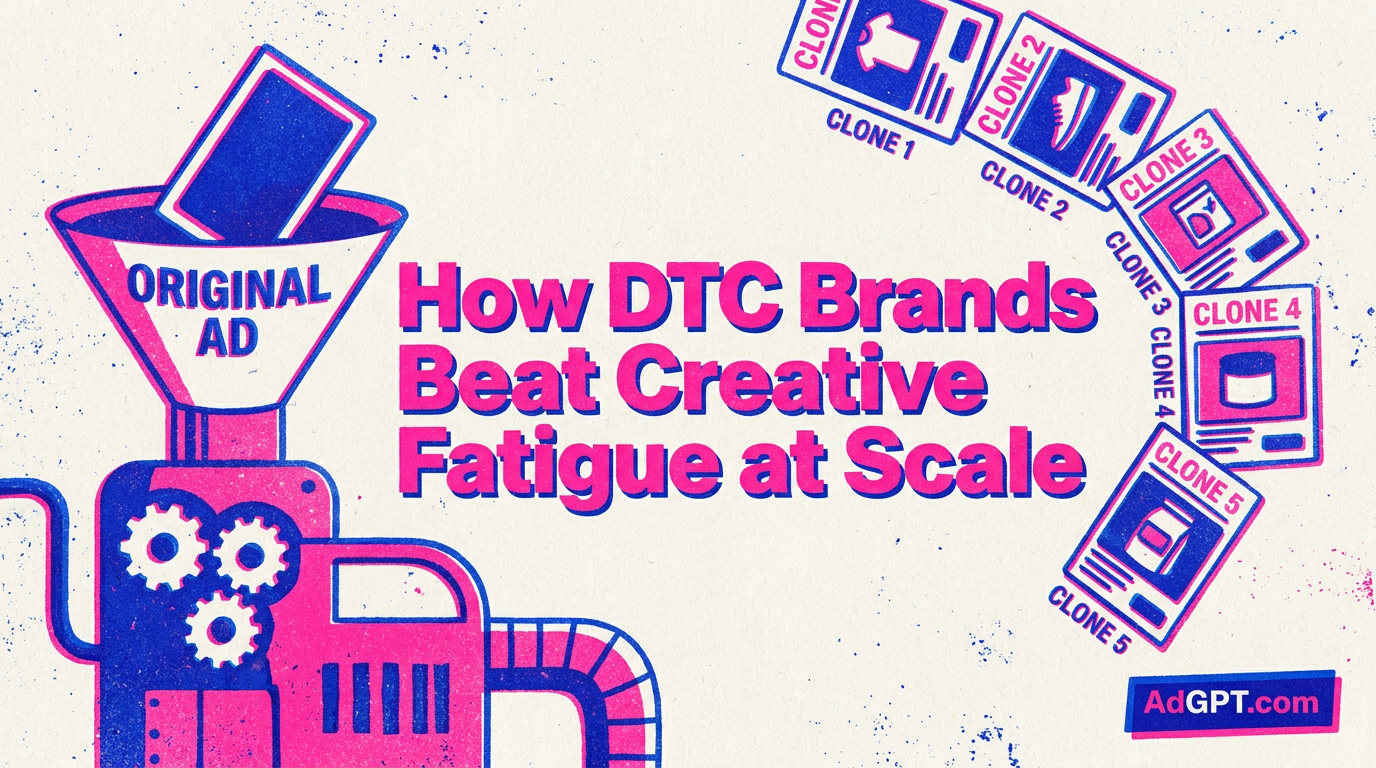
Ad clone technology lets performance marketers copy the structure, format, and messaging of a proven ad — then rapidly generate variants across Meta, TikTok, and YouTube without starting from scratch. For DTC brands battling creative fatigue and rising CPMs, it is one of the highest-leverage tactics available in 2026.
Why Creative Fatigue Is the Real CPM Problem
Meta's own data shows ad frequency above 3.0 correlates with a measurable drop in click-through rate for most consumer categories. When an audience has seen the same creative repeatedly, CPMs rise not because inventory costs more — but because the algorithm deprioritizes low-engagement ads, forcing you to bid higher for the same reach. The root cause is almost always a thin creative library.
DTC brands running performance campaigns typically need 15–30 active creative variants per product line to maintain healthy frequency distribution. Most in-house teams produce fewer than five per month. That gap is where creative fatigue starts and where ad cloning closes the distance fast.
Direct-to-consumer reporting at D2C Times has tracked how founder-led brands that systematically iterate on their top performers consistently outperform those chasing net-new concepts — a pattern that makes ad cloning a structural advantage rather than a shortcut.
What Ad Cloning Actually Means for Paid Media
Ad cloning is not plagiarism. It is the disciplined practice of extracting what works — hook structure, visual hierarchy, CTA placement, offer framing — from a proven ad and rebuilding it with fresh assets, copy angles, or audience-specific language. The goal is to transfer the performance DNA of a winner without burning the same creative into fatigue.
There are three levels at which DTC marketers apply ad cloning:
- Format cloning: Replicating the aspect ratio, scene sequence, and text overlay pattern of a high-performing video while swapping the product footage or spokesperson.
- Copy cloning: Preserving the hook formula and CTA structure while changing the angle — for example, shifting from a pain-point hook to a social-proof hook.
- Full creative cloning: Rebuilding an entire ad concept in a new aesthetic or for a new platform (e.g., adapting a Facebook carousel into a TikTok vertical video).
Each level requires different inputs, but all three share a common starting point: identifying which ads are actually worth cloning. That means sorting by ROAS or CPA at the ad level — not the campaign level — and flagging creatives that have held a cost-per-purchase below target for at least 14 days.
How to Build an Ad Clone Workflow in 5 Steps
- Audit your top 10% of ads by CPA over 30 days. Pull ad-level data from Meta Ads Manager or TikTok Ads and sort by cost-per-purchase ascending. The ads in the top decile are your clone candidates.
- Deconstruct the winner. Document the hook (first 3 seconds), the value proposition sequence, any social proof elements, the CTA, and the visual format. Write this down as a template, not a description.
- Generate variants using an AI ad tool. Feed the template into an AI ads generator alongside your product URL or asset library. A capable tool should produce 5–10 variants in under 10 minutes, changing copy angles, visuals, or both while preserving the structural logic of the original.
- Adapt for each platform's native format. A winning Facebook video rarely ports directly to TikTok without modification. Use a platform-specific tool — for example, a Facebook ads generator optimized for feed and Reels placement — to ensure aspect ratios, text safe zones, and caption styles match platform expectations.
- Launch in a dedicated test campaign and set a kill threshold. Run cloned variants in a Creative Testing campaign with a fixed daily budget ($50–$100 per variant). Set a spend threshold — typically 2x your target CPA — at which you pause underperformers and promote winners to your main campaign.
Ad Clone vs. Starting from Scratch: A Performance Comparison
The table below summarizes the practical differences between a from-scratch creative process and a clone-first workflow for a DTC brand spending $30,000 per month on paid social.
| Metric | From-Scratch Creative | Ad Clone Workflow |
|---|---|---|
| Time to produce 10 variants | 2–4 weeks | 1–3 hours |
| Average cost per creative | $500–$2,000 (agency or freelance) | $5–$30 (AI tooling) |
| Baseline performance predictability | Low — new concept, no proven structure | High — inherits winner's structural DNA |
| Creative library growth per month | 3–8 new ads | 30–80 new ads |
| Fatigue risk at 4-week mark | High — small library rotates fast | Low — large library distributes frequency |
| Suitable for multi-platform scaling | Requires separate production runs | Reformatting handled by AI resizer/tool |
Choosing the Right Ad Clone Tool for DTC Scale
Not every AI creative tool supports genuine ad cloning. Many offer template libraries that look similar but lack the ability to ingest a specific existing ad and generate structured variants from it. When evaluating options, DTC marketers should look for four capabilities: URL-to-ad ingestion, platform-native output formats, copy angle variation, and batch export.
AdGPT's Creatify AI alternative is built specifically for teams that need to move from one winning ad to a full variant library without a production bottleneck. Unlike Creatify, which is primarily a video generation tool, AdGPT covers static, video, and UGC-style formats inside a single workflow — which matters when a DTC brand needs to feed Meta's Advantage+ Creative and TikTok's Smart Performance Campaigns simultaneously.
For Shopify store owners running their own paid media, the ecommerce ad creator pulls product data directly from a store URL and generates platform-ready variants without requiring design files or a creative brief. That removes the most common bottleneck for lean teams: the handoff between product and marketing.
The strategic logic behind clone-first workflows is explored in depth in The Shift: From Creating Content to Recreating What Works — a useful read for any performance marketer who still spends the majority of their creative budget on net-new concepts rather than iteration.
Common Mistakes That Undermine Ad Clone Performance
Ad cloning done poorly produces a different problem than creative fatigue — it produces a library of ads that all look and sound identical, which audiences learn to ignore just as fast. Three errors account for most failed clone strategies:
- Cloning before statistical significance. Pulling a 3-day winner with 200 impressions and building 20 variants from it is not cloning a winner — it is amplifying noise. Wait for at least 50 purchases or 7 days at meaningful spend before designating an ad as a clone candidate.
- Cloning the aesthetic instead of the structure. The color palette of a winning ad is not what made it work. The hook pacing, the specificity of the value proposition, and the CTA verb are. Strip out the superficial and replicate the architecture.
- Ignoring platform-native behavior. A 30-second Facebook video that converts well will not automatically translate to TikTok, where 60% of conversions from video ads occur before the 10-second mark according to TikTok for Business benchmarks. Each clone must be adapted, not just resized.
Teams scaling UGC-style content face an additional layer of complexity around compliance and brand consistency. The approach covered in AI UGC Creator: How Affiliates Generate Compliant Creative at Scale is directly applicable to DTC brands running creator-style clone variants at volume.
Scaling Beyond Cloning: Building a Systematic Creative Engine
Ad cloning is most powerful as part of a broader creative testing system, not as a one-time fix. The highest-performing DTC media teams in 2026 operate on a three-tier model: a small number of net-new concept tests each month, a larger volume of clone variants derived from proven winners, and a continuous retirement schedule for ads that have crossed frequency thresholds.
At the tooling level, this means using an AI creative platform that supports all three tiers — concept generation, variant production, and performance-linked creative analysis — without requiring separate tools for each stage. The brands that scale paid media profitably are those that treat creative as a data problem, not a design problem. Ad cloning is the methodology. The right tool is what makes it repeatable.
Frequently asked questions
What is ad cloning in digital marketing?
How does ad cloning help reduce creative fatigue?
Is ad cloning the same as copying a competitor's ad?
How many ad variants should a DTC brand have running at once?
What makes AdGPT better than Creatify for ad cloning?
How long should an ad run before I clone it?
🤖 Explore this article with AI



Daniel Rozin
Get featured in this article
Place your brand in front of thousands of marketers and decision-makers. Pick the articles, add your links and anchor text, and our editors handle the integration — with an answer within 24 hours.
- $200Editorial Mention
- $500Expanded Editorial
- $1,250Featured Placement
We don't do link exchanges or free swaps — placements are paid and subject to editorial review. If a placement isn't approved, it's fully refunded.


